Why a European Windbreaker Brand Changed Manufacturers
Why a European Windbreaker Brand Changed Manufacturers
Share
Issue Time
2026/10/23 15:40:17
Summary
A European windbreaker brand was satisfied with its jackets but frustrated by slow, unclear supplier communication. This real customer case explains why the founder moved to VANRD and how a dedicated contact, practical technical advice, and clearer specifications made development easier.
Real Customer Case · Europe
Why a European Windbreaker Brand Changed Manufacturers
The jackets were fine. The communication wasn't. See why a founder-led brand moved to VANRD for clearer technical guidance, quicker decisions and a more supportive development process.
Supplier Transition · Windbreaker OEM / ODM
The story behind the switch
When you're developing a custom windbreaker without an in-house technical designer, you need more than a factory that can sew. You need someone who can answer questions about fabric, fit, panels and trims before a small uncertainty becomes a production decision.
That was the problem for the founder of an independent European windbreaker brand. He was not leaving his previous supplier because the jackets were badly made. The products were acceptable, and delivery was roughly on schedule. But getting useful answers had become difficult.
“The other supplier was not friendly. I had the feeling of annoying her every time.”
— Founder of the European windbreaker brand (name withheld)
The customer
Founder-led European windbreaker brand managing product decisions without an in-house technical designer.
The challenge
Slow or vague supplier responses made routine product decisions harder than they needed to be.
VANRD’s approach
A dedicated point of contact, clearer response expectations, recommendations and documented specifications.
Customer identity and identifiable product details are withheld for confidentiality. This case describes a real client relationship; it does not report sales or growth figures.
01
The initial problem
The Jackets Weren't the Problem. The Decisions Were.
Windbreakers contain many small but connected development choices: shell fabric, water-repellent treatments, hood shape, zippers, cuffs, pockets, lining and panel layout. A founder may know exactly how the finished jacket should feel and look, without knowing the best construction answer to every technical question.
At the previous supplier, questions could take too long to resolve, and responses sometimes left the choice entirely with the customer. Instead of receiving a recommendation, the founder was being asked to make decisions without enough supporting information.
The result was not an obvious production failure. It was a communication problem that made him less comfortable asking for clarification. In clothing development, that matters: an approved sample records what has been agreed, including any uncertainty the customer did not feel able to raise.
What this case illustrates: On a technically detailed jacket, supplier responsiveness is part of the development process—not simply an after-sales courtesy.
02
Our working approach
Five Changes That Made Working Together Easier
We did not begin by redesigning the whole jacket. We focused on how questions, approvals and changes would move between the founder and our team. Here are the five practices described in this project.
CHANGE 01
A clear point of contact
The founder had a named person to speak with, reducing repeated explanations and uncertainty about who was responsible for an answer.
CHANGE 02
Stated response expectations
We communicated when he could expect the next reply. Even when a technical answer required checking, he knew what the next step would be.
CHANGE 03
Recommendations, not just options
When more than one material or construction approach was possible, we explained the trade-off and which option we would recommend for his design.
CHANGE 04
Measurements before sampling
We worked from written, measured specifications based on his references so that revisions could be discussed precisely. Our clothing tech pack guide explains the type of information such documents should contain.
CHANGE 05
Early notice when something needs attention
We made it a working principle to raise changes affecting timing, cost or the specification as soon as they became known, rather than leaving the customer to discover them later. This also supports the wider development-to-production process.
03
A specific technical discussion
Why Small Windbreaker Details Needed Clear Answers
Two topics from the project's development discussions show why a helpful manufacturing partner must do more than say “either option is fine.”
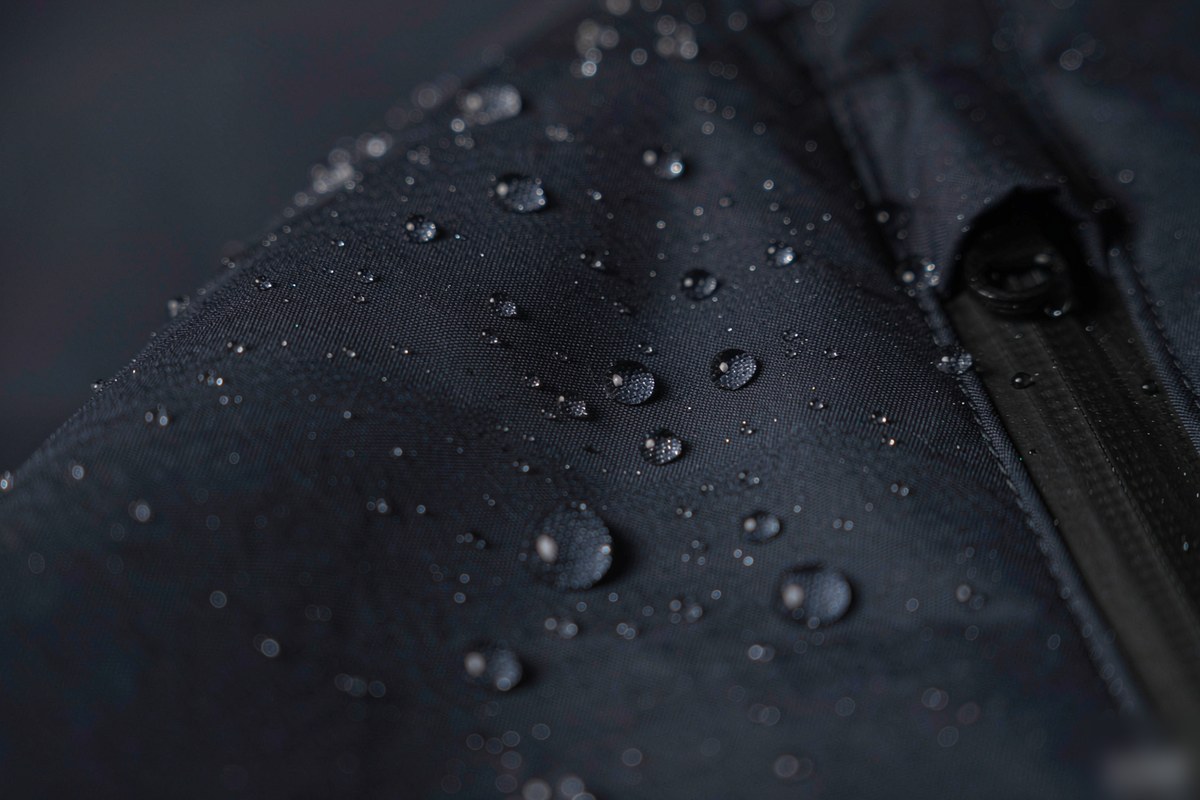
Illustration of water beading on shell fabric. This is a material reference, not a photograph of the customer's proprietary jacket.
Water-repellent is not automatically waterproof
A durable water-repellent (DWR) finish can encourage droplets to bead on a fabric surface. That alone does not establish whether an entire jacket is waterproof. Fabric construction, coatings or membranes, seams and garment design affect the final level of protection.
Water-repellentDesigned to shed some surface moisture under suitable conditions.
WaterproofRequires an appropriate fabric and garment construction, supported by suitable testing for the claim.
For this brand, distinguishing the two helped keep the development brief and product expectations aligned. Our windbreaker manufacturing guide covers shell and lining decisions in more detail.
Panel geometry had to be specified, not guessed
The second discussion concerned color-block placement. Where a panel begins, how it crosses a sleeve, and how it meets the zipper or shoulder seam all affect the appearance of a jacket. Phrases such as “navy chest panel” leave too much open to interpretation. Documenting the layout before cutting helped settle those details earlier.
This is one reason we connect a design reference to measurements, diagrams and sample approvals rather than relying on descriptions alone. Similar checks matter in custom jacket development more broadly.
04
What changed for the customer
The Outcome Was a Smoother Development Relationship
The reported benefit was not a dramatic new sales figure. It was a process the founder no longer felt he had to chase at every stage. The original account describes samples arriving within the communicated window, fewer open-ended revisions after specifications were agreed, and earlier decisions on panel placement.
Clearer answers
Technical questions came back with explanations and recommendations, not only a list of possibilities.
More defined approvals
Written specifications gave the founder and our team a common basis for reviewing sample details.
Less uncertainty
Response expectations made the collaboration easier to manage alongside the founder's other responsibilities.
“Way more happy to give money to you. You and your team are friendly and doing top tier job, and your answers are always nice and clear.”
— Customer feedback shared during the VANRD collaboration; identity withheld
That second message is particularly meaningful to us. The praise was not only about friendliness. The founder valued answers that were clear enough to make decisions with.
What we are not claiming: We do not have independently verified sales uplift, repeat-order percentages or reduced return rates for this case, so none are presented as results. Production timelines vary by project; see our sampling and bulk production timeline guide for planning considerations.
05
A useful takeaway for other brands
Three Questions to Ask Before Switching Clothing Manufacturers
A factory can produce a good-looking sample and still be difficult to work with. If your current supplier is slowing down product decisions, try these questions before your next development round.
Fabric: Which shell material would you recommend for our intended use, and what trade-offs should we expect?
Construction: Which specification details must we confirm before sampling or cutting?
Timing: Who will update us if an approval, material or production milestone changes?
The value is in the quality of the response, not just its speed. A useful manufacturer should explain the reason behind a recommendation, identify what remains uncertain, and document what has been approved. Our guide to choosing a reliable clothing manufacturer offers a broader evaluation framework.
Looking for a More Responsive Windbreaker Manufacturer?
If you're developing a new shell jacket or considering a supplier change, share your design references or tech pack, planned quantity, target market and timeline. Our team can review the requirements and discuss the next practical step. Explore our OEM/ODM manufacturing services or get in touch below.
About this customer story: To protect our client's privacy, the brand name and identifying details have been withheld. Images are for illustrative purposes only.