Top 10 Streetwear Manufacturers for Private Label Brands in 2026
- Share
- publisher
- Vanrd
- Issue Time
- Apr 20,2026
Summary
A practical 2026 guide for private label brands comparing streetwear manufacturers. Learn the 10 manufacturer types to evaluate, what each is suitable for, and how to check sampling, fabric, trims, MOQ, QC, and production capability before choosing a supplier.
The best streetwear manufacturer for a private label brand depends on product category, sampling needs, fabric and trim requirements, MOQ, production scale, and QC control. In 2026, brands should compare manufacturers by capability fit, not only by price or product photos. A strong supplier should help clarify tech packs, samples, materials, branding details, production workflow, and inspection standards before bulk production.
Quick Answers
What is a private label streetwear manufacturer?
A private label streetwear manufacturer is a factory or production partner that helps brands make garments under their own label. Depending on the supplier, this can include tech pack review, fabric sourcing, sampling, bulk production, logo application, labels, packaging, and QC.
How should brands choose a streetwear manufacturer in 2026?
Brands should choose a streetwear manufacturer by matching supplier capability to product category, target quality, MOQ, sampling complexity, trims, fabric needs, and bulk production requirements. A low price is not useful if the factory cannot control fit, finishing, and delivery communication.
What type of manufacturer is best for a startup streetwear brand?
A startup brand may need a manufacturer that can support clear sampling, small-batch planning, basic tech pack improvement, and flexible communication. However, the brand still needs to prepare reference images, size charts, artwork, target quantity, and quality expectations.
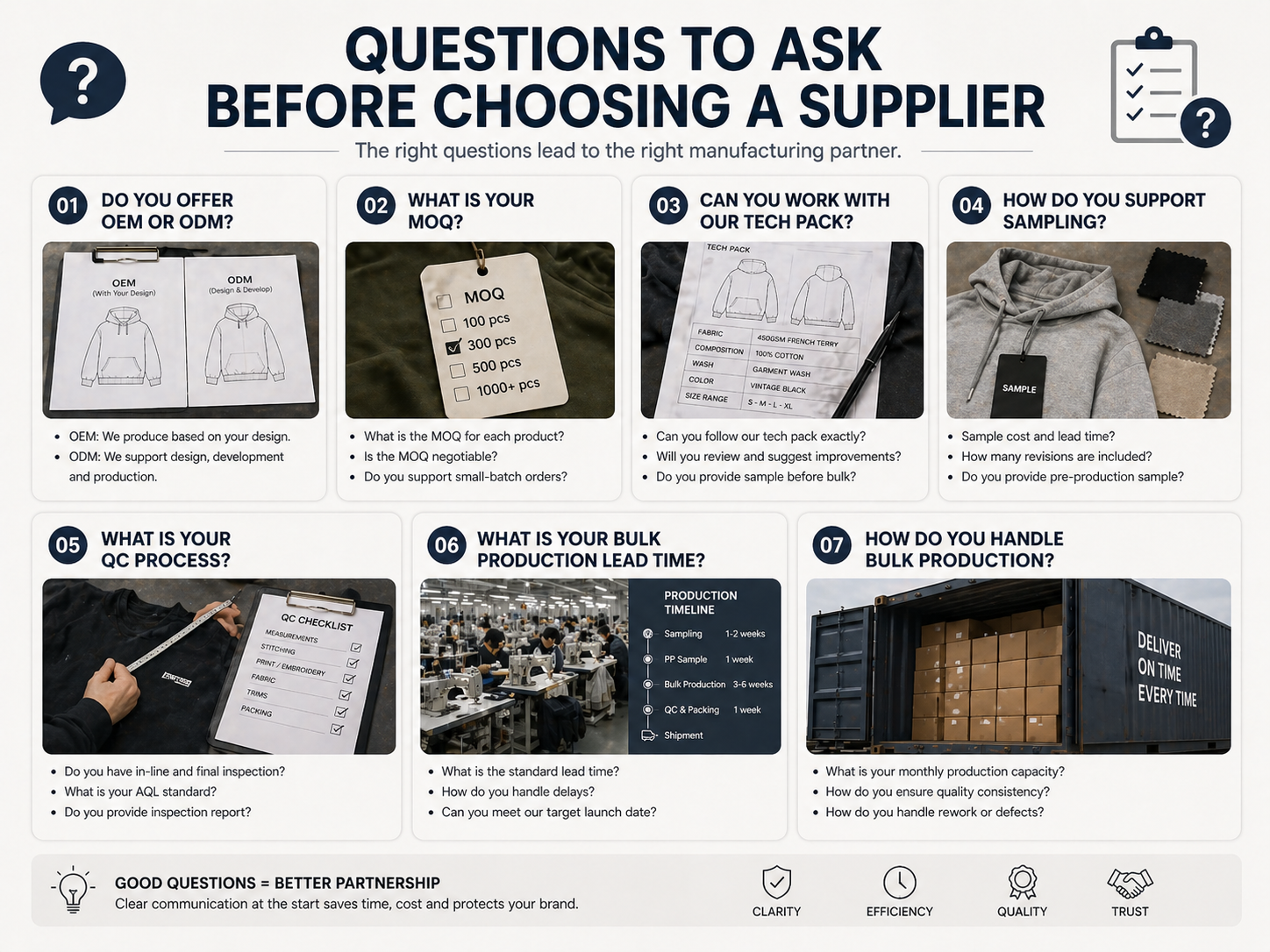
What should private label brands ask before sampling?
Brands should ask about fabric options, sample process, MOQ, estimated production variables, logo techniques, trim sourcing, size tolerance, QC process, and packaging support. These questions help identify whether the manufacturer is suitable before paying for samples.
Is an OEM or ODM manufacturer better for streetwear?
OEM is usually more suitable when the brand already has its own design, tech pack, fit, artwork, and branding direction. ODM may be more suitable when the brand needs development support or wants to modify existing concepts. The right model depends on design control and project maturity.
Can one factory make all streetwear categories?
Some factories can support multiple categories, but not every supplier is equally strong in hoodies, denim, jackets, tracksuits, T-shirts, and pants. Brands should check category-specific samples, construction details, fabric knowledge, and QC experience before assuming one factory can handle every product.
What makes a streetwear manufacturer reliable?
A reliable streetwear manufacturer communicates clearly, checks technical details before production, provides realistic production feedback, controls fabric and trim approvals, supports sample revisions, and aligns QC standards before bulk production.
Why This Is Not a Simple Ranking List
A "top 10 streetwear manufacturers" list can be misleading if it ranks companies without clear evidence, factory visits, verified buyer feedback, or comparable production data. For private label brands, a better approach is to compare manufacturer types and match them with the brand's real production needs.
A hoodie-focused factory may be strong for fleece programs but weak in denim washes. A denim specialist may be excellent for jacket washing but not ideal for technical tracksuits. A large bulk factory may control volume well but may not be the right fit for a brand still refining its first sample.
For this reason, this guide explains 10 types of streetwear manufacturers private label brands should compare in 2026. It is designed to help buyers build a more practical shortlist before contacting suppliers, requesting samples, or moving into bulk production.
Brands that need OEM/ODM development support can also review Vanrd's custom OEM/ODM apparel manufacturing services to understand how streetwear projects can move from idea to sample and production.
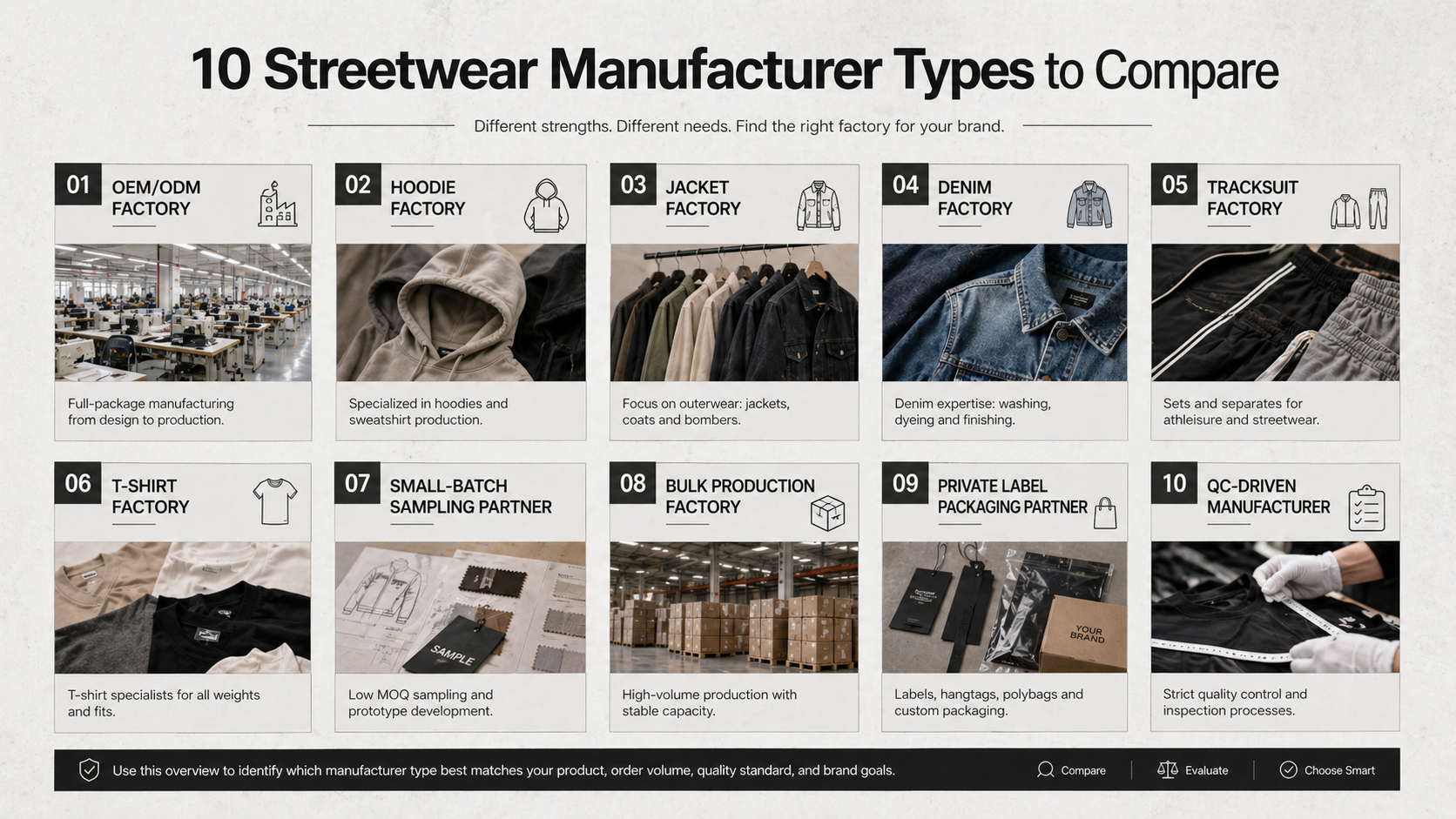
Top 10 Streetwear Manufacturer Types to Compare in 2026
The right manufacturer depends on what your brand is producing, how mature your design files are, and how much development support you need. Below are 10 manufacturer types private label brands should understand before choosing a production partner.
1. Full OEM/ODM Streetwear Manufacturer
A full OEM/ODM streetwear manufacturer is suitable for brands that need support across multiple stages, including design review, fabric sourcing, sample development, bulk production, quality control, and private label packaging.
This type of manufacturer is useful when the brand wants to develop a consistent product line across hoodies, jackets, T-shirts, pants, denim, or tracksuits. It can also be useful when the buyer needs one production partner to coordinate several product categories.
Best for:
Private label brands building a full collection
Streetwear brands that need multiple product categories
Brands that want development and production support in one workflow
Buyers who need fabric, trims, sample, and QC coordination
What to check:
Does the factory understand streetwear fits?
Can it handle different fabric categories?
Does it support logo techniques and private label packaging?
Can it explain sample and bulk production stages clearly?
Does it have a clear QC workflow?
Vanrd is positioned as a B2B apparel manufacturer in Dongguan (Humen), China, supporting OEM/ODM, private label, sampling, bulk production, and quality control for streetwear and related categories.
2. Cut-and-Sew Hoodie Manufacturer
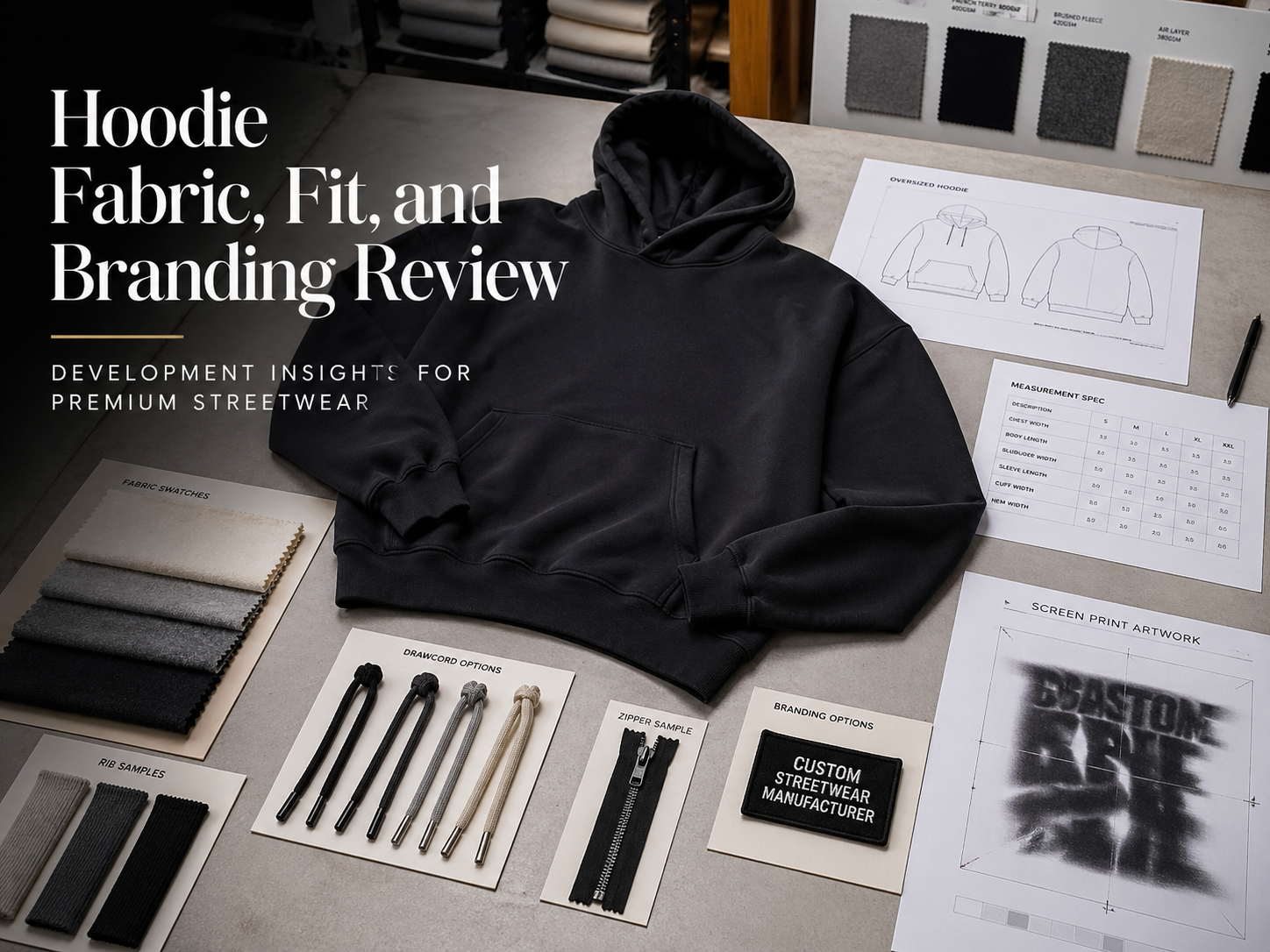
A cut-and-sew hoodie manufacturer is suitable for brands that need custom patterns, heavyweight fleece, oversized silhouettes, washed effects, zipper hoodies, pullover hoodies, or special branding details.
Hoodies are one of the most important streetwear categories, but they are also easy to get wrong. Fabric weight, shrinkage, rib quality, hood shape, pocket construction, shoulder drop, and logo placement all affect the final result.
Best for:
Oversized hoodies
Washed hoodies
Zip hoodies
Heavyweight fleece programs
Graphic hoodie drops
Private label hoodie collections
What to check:
Can the factory control shrinkage after washing?
Can it make the hood shape and shoulder drop correctly?
Can it source suitable fleece, rib, drawcords, and zipper trims?
Can it apply print, embroidery, patch, or applique details?
Can it maintain measurement tolerance across bulk production?
3. Jacket and Outerwear Manufacturer
A jacket and outerwear manufacturer is suitable for brands developing varsity jackets, bomber jackets, work jackets, racing jackets, coach jackets, or technical streetwear outerwear.
Jackets usually involve more components than T-shirts or basic hoodies. They may include lining, padding, zippers, snaps, rib, pockets, patches, embroidery, special panels, and more complex sewing operations.
Best for:
Varsity jackets
Bomber jackets
Work jackets
Racing jackets
Coach jackets
Custom streetwear outerwear
What to check:
Can the factory control jacket structure and lining?
Can it handle rib, zipper, snap, and pocket construction?
Can it develop patches, embroidery, or special trims?
Does it understand outerwear measurement tolerance?
Can it inspect symmetry, seam strength, and front closure alignment?
For brands comparing jacket or outerwear programs, Vanrd's factory strength and production capability page can support supplier evaluation and capability review.
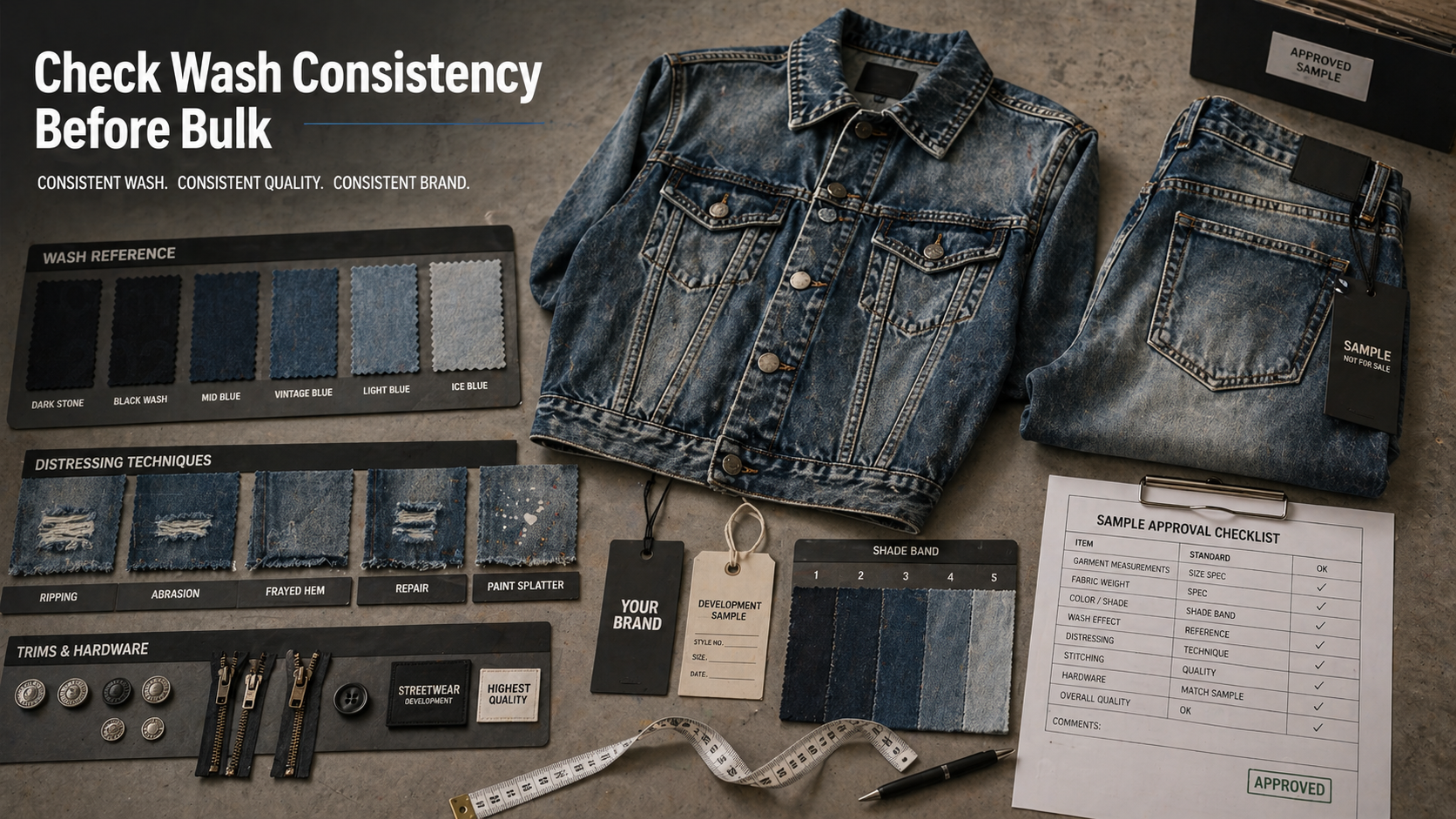
4. Denim and Washed Streetwear Manufacturer
A denim and washed streetwear manufacturer is suitable for brands developing denim jackets, jeans, washed pants, vintage-effect styles, distressed garments, or other wash-heavy streetwear pieces.
Denim and wash programs require stronger control over fabric, shrinkage, color, hand feel, wash recipe, distressing placement, and bulk consistency. A supplier that is good at basic sewing may not be suitable for complex wash development.
Best for:
Denim jackets
Washed jeans
Vintage washed pants
Distressed streetwear pieces
Enzyme wash or stone wash programs
Garment-dyed or washed collection concepts
What to check:
Can the factory control wash shade and shrinkage?
Can it provide wash references before bulk approval?
Can it control distressing placement?
Can it match the approved sample in bulk?
Can it explain wash risk before production?
5. Tracksuit and Sportswear-Inspired Streetwear Manufacturer
A tracksuit manufacturer is suitable for brands developing nylon tracksuits, polyester tracksuits, warm-up suits, streetwear track jackets, track pants, and sport-inspired lifestyle sets.
Tracksuits require balance between jacket and pants. Fabric, lining, zipper, elastic, drawcord, pocket position, and fit must work together as a set. If the jacket and pants are developed separately without set balance, the final look can feel inconsistent.
Best for:
Nylon tracksuits
Polyester tracksuits
Warm-up suits
Track jackets
Track pants
Sport-inspired streetwear collections
What to check:
Can the factory develop jacket and pants as a coordinated set?
Can it source nylon, polyester, mesh, lining, zipper, and elastic options?
Can it control waistband comfort and pants fit?
Can it keep logo placement consistent across the set?
Can it inspect zipper, drawcord, and elastic function?
Brands planning material-heavy projects can review Vanrd's fabric and technique customization support before confirming fabric, trims, and logo methods.
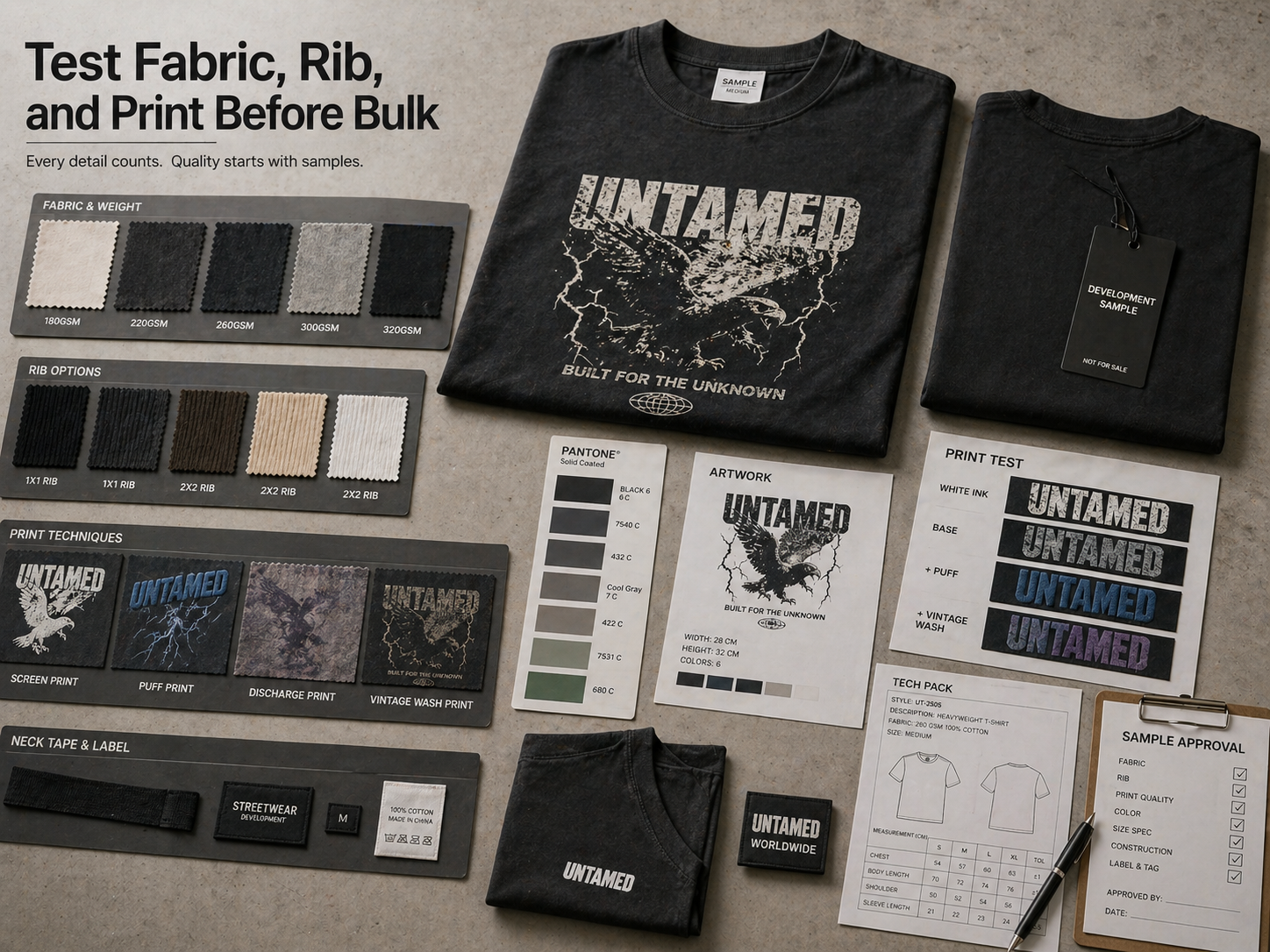
6. Graphic T-Shirt Manufacturer
A graphic T-shirt manufacturer is suitable for brands focused on blanks, cut-and-sew tees, heavyweight jersey, oversized T-shirts, washed tees, screen printing, DTG, heat transfer, embroidery, or mixed graphic techniques.
T-shirts may look simple, but streetwear T-shirt production depends on fabric weight, collar rib, shoulder shape, body length, shrinkage, print hand feel, and bulk print consistency.
Best for:
Oversized T-shirts
Heavyweight tees
Washed tees
Graphic drops
Cut-and-sew T-shirts
Private label blank programs
What to check:
Can the factory control collar rib shape?
Can it manage shrinkage after washing?
Can it apply the required print technique?
Can it maintain print placement and color consistency?
Can it support label and packaging customization?
7. Pants and Utility Bottoms Manufacturer
A pants-focused streetwear manufacturer is suitable for cargo pants, workwear pants, baggy pants, track pants, denim pants, carpenter pants, shorts, and utility bottoms.
Pants need strong pattern control because rise, thigh width, knee width, inseam, leg opening, waistband, and pocket position all affect fit. Utility pants also require better trim and pocket construction control.
Best for:
Cargo pants
Workwear pants
Baggy pants
Track pants
Carpenter pants
Streetwear shorts
Utility bottoms
What to check:
Can the factory control rise and leg shape?
Can it make complex pocket structures?
Can it source suitable zippers, snaps, drawcords, or webbing?
Can it keep pocket placement consistent?
Can it inspect waistband and seam strength?
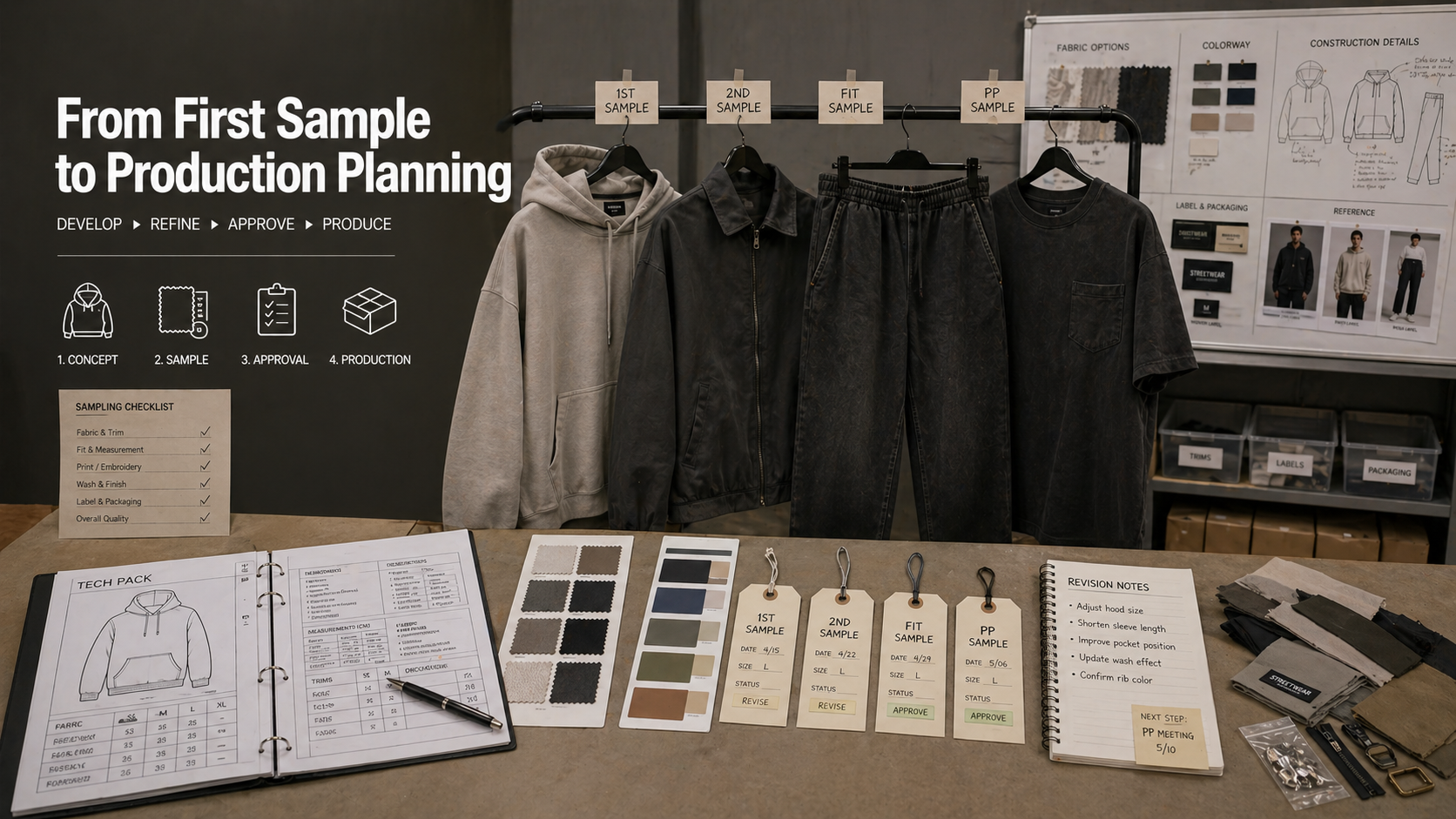
8. Small-Batch Sampling Manufacturer
A small-batch sampling manufacturer is suitable for brands still testing product-market fit, refining designs, or preparing a first collection before larger production.
This type of manufacturer should be judged by communication clarity, sample accuracy, technical feedback, and revision management. However, brands should confirm whether the supplier can also scale production later, because a good sample partner is not always a strong bulk production partner.
Best for:
Startup brands
First sample development
Design testing
Small collection validation
Fit and fabric exploration
What to check:
Can the factory explain what information is missing?
Can it help refine incomplete tech packs?
Can it produce a sample that reflects bulk feasibility?
Can it clearly separate sample cost from bulk cost?
Can it scale later if the product performs well?
9. Bulk Production Streetwear Factory
A bulk production factory is suitable for brands that already have approved samples, stable sales channels, confirmed sizing, and predictable order planning.
This type of factory should be evaluated by production planning, material sourcing control, inline inspection, final QC, packing consistency, and delivery communication. It may not be the best option for brands that are still changing the design repeatedly.
Best for:
Established brands
Repeat orders
Larger production programs
Stable styles
Wholesale and distribution planning
What to check:
Can the factory plan production capacity realistically?
Can it source approved fabric and trims consistently?
Can it control measurement tolerance in bulk?
Can it provide inline and final inspection?
Can it manage packing, labeling, and carton requirements?
For production workflow and approval stages, buyers can review Vanrd's custom apparel service process.
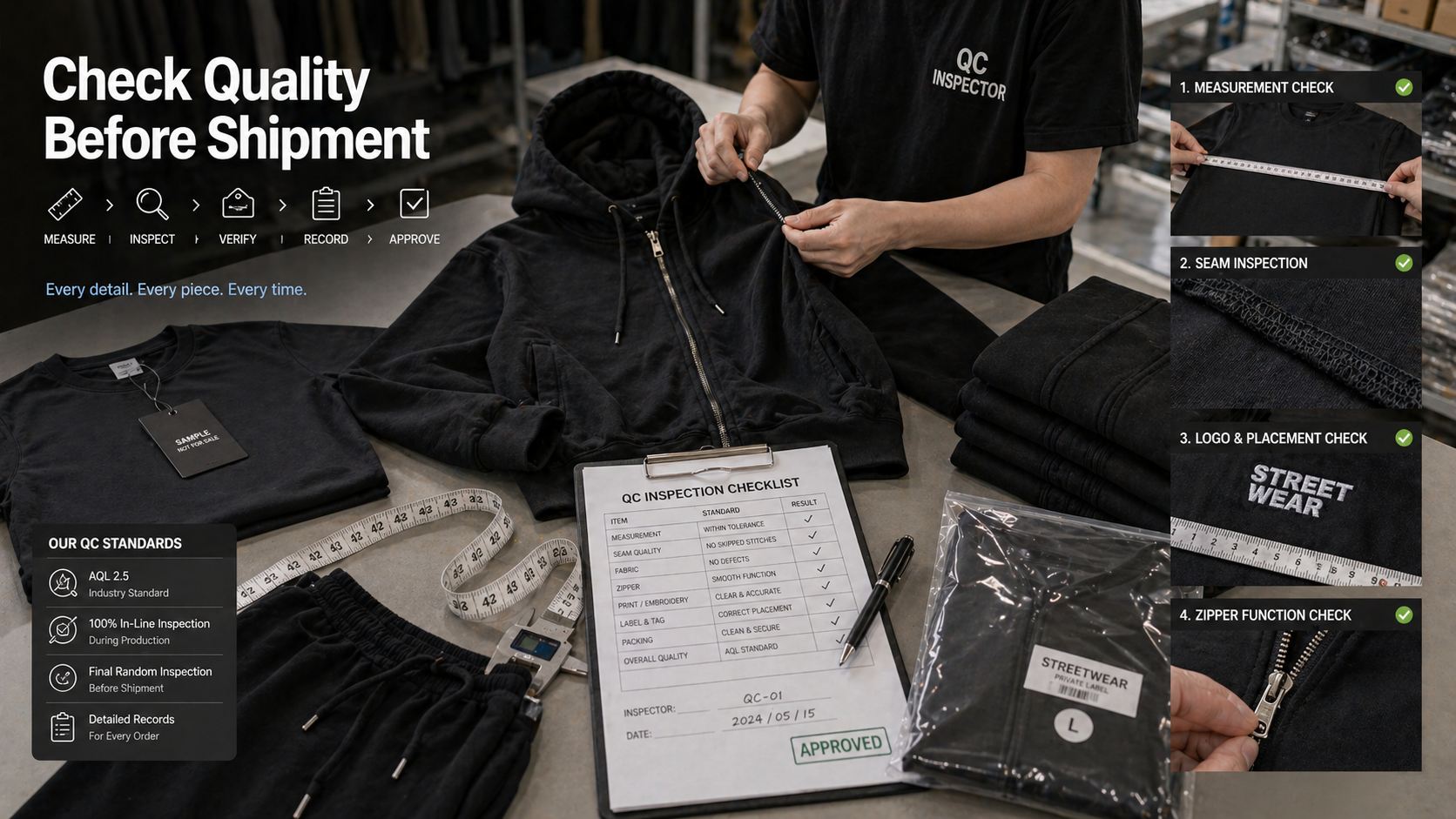
10. QC-Driven Private Label Manufacturer
A QC-driven private label manufacturer is suitable for brands that care about consistency, measurement control, seam quality, branding accuracy, packing requirements, and long-term reorder stability.
This supplier type is especially important when the product has multiple sizes, trims, fabrics, logo placements, or buyer-specific packaging standards. QC should not begin only at the end. It should be built into fabric approval, sample review, pre-production confirmation, inline checks, and final inspection.
Best for:
Brands scaling production
Wholesale buyers
Merch buyers
Multi-size programs
Repeat private label orders
Quality-sensitive streetwear collections
What to check:
Does the factory define QC points before bulk production?
Does it check fabric, measurements, stitching, trims, logo, and packing?
Can it document approval standards?
Can it communicate problems early?
Can it support consistent repeat orders?
For quality-related questions, buyers can review Vanrd's quality control and inspection standards.
Comparison Table: Which Manufacturer Type Fits Your Brand?
| Manufacturer Type | Best For | Main Strength | Main Risk to Check |
| Full OEM/ODM streetwear manufacturer | Multi-category private label collections | End-to-end development and production | Must confirm category-specific capability |
| Cut-and-sew hoodie manufacturer | Hoodie and fleece programs | Fit, fleece, rib, and logo control | Shrinkage and size tolerance |
| Jacket and outerwear manufacturer | Varsity, bomber, work, and racing jackets | Complex construction and trims | Lining, closure, and symmetry control |
Denim and washed streetwear manufacturer | Denim jackets, jeans, washed garments | Wash development and fabric control | Shade difference and shrinkage |
Tracksuit manufacturer | Nylon and polyester sets | Jacket and pants coordination | Elastic, zipper, and set balance |
Graphic T-shirt manufacturer | Tees and graphic drops | Fabric and print execution | Print hand feel and placement |
Pants and utility bottoms manufacturer | Cargo, workwear, and baggy pants | Pattern and pocket construction | Rise, leg shape, and pocket position |
Small-batch sampling manufacturer | Early-stage product testing | Flexible development | May not scale well |
Bulk production factory | Repeat or larger orders | Production planning and consistency | Less suitable for unstable designs |
QC-driven private label manufacturer | Scaling brands and wholesale buyers | Inspection and repeat consistency | Requires clear approval standards |
What Private Label Brands Should Check Before Contacting a Manufacturer
Before contacting a streetwear manufacturer, brands should prepare enough information for the supplier to judge feasibility, sampling direction, and quotation variables.
Product Category
Start by defining the exact product category. A general phrase like "streetwear collection" is too broad. Be specific about whether the project includes hoodies, jackets, T-shirts, pants, tracksuits, denim, shorts, or mixed categories.
Design Files
Prepare tech packs if available. If the tech pack is not ready, send reference images, size direction, garment measurements, logo artwork, color standards, and construction notes.
Fabric Direction
Fabric choice affects cost, fit, shrinkage, production process, and quality control. Brands should explain whether they need fleece, jersey, nylon, polyester, denim, twill, canvas, rib, mesh, lining, or special fabric finishes.
Branding Requirements
Confirm whether the product needs screen printing, embroidery, heat transfer, woven patches, rubber patches, labels, hangtags, custom packaging, or special trims.
Target Quantity
The target quantity affects MOQ feasibility, material sourcing, pricing, and production planning. If the brand is still testing, it should explain the first order plan and potential repeat order expectation.
QC Expectations
Brands should define what matters most: measurement accuracy, fabric hand feel, wash effect, print durability, trim function, packaging consistency, or shipment inspection.
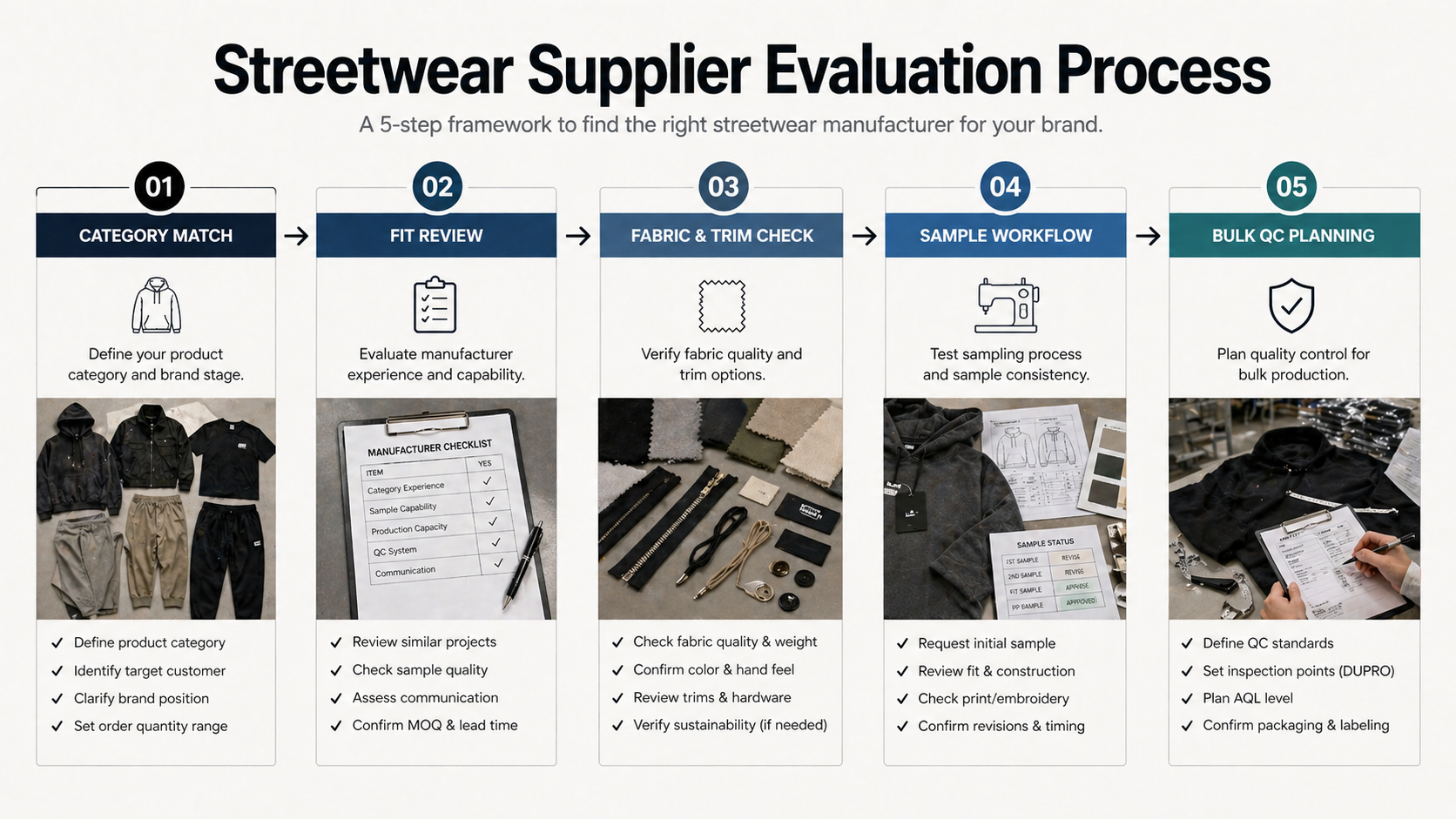
How to Evaluate a Streetwear Manufacturer Step by Step
A good manufacturer evaluation process should move from capability check to sample approval, then to production planning.
Step 1: Match the Factory to Your Product Category
Do not choose a supplier only because it says it can make streetwear. Ask for category-relevant examples. If you are making varsity jackets, review jacket construction. If you are making hoodies, review fleece, rib, hood shape, and shrinkage control.
Step 2: Check Whether the Supplier Understands Your Fit
Streetwear fit is not only about size. Oversized, boxy, relaxed, cropped, tapered, wide-leg, and athletic fits all require different pattern logic. The supplier should understand the silhouette before sampling.
Step 3: Confirm Fabric and Trim Development Ability
The manufacturer should be able to discuss fabric options, weight, hand feel, trims, labels, packaging, and logo techniques. If a supplier cannot explain material options clearly, sampling may become slow and inaccurate.
Step 4: Ask About Sampling Workflow
A clear sampling workflow usually includes project review, fabric and trim confirmation, sample making, sample comments, revision if needed, and final approval before bulk production.
Step 5: Discuss Bulk Production Risk
Before placing a bulk order, discuss measurement tolerance, fabric approval, trim approval, logo standard, packing method, inspection points, and delivery variables.
Factory Reality: Why Some Streetwear Manufacturers Look Similar but Perform Differently
Many manufacturers may show similar product photos online, but their real capability can be very different. The difference usually appears during technical communication, sample development, material sourcing, revision handling, and bulk inspection.
Product Photos Are Not Enough
A product photo does not show whether the factory controlled shrinkage, checked measurements, sourced the fabric, managed trims, or inspected bulk production. Buyers should use product photos as a starting point, not as proof of full capability.
Sampling Quality Does Not Always Equal Bulk Quality
A sample can be made carefully by a small team, but bulk production requires repeatable process control. Brands should ask how the factory transfers sample standards into bulk production.
Category Experience Matters
A factory that is strong in T-shirts may not be strong in jackets. A hoodie supplier may not understand denim washing. A pants factory may not be ideal for complex outerwear. Category fit should be checked early.
Communication Speed Affects Production Risk
Slow or unclear communication can delay fabric approval, sample revisions, trim confirmation, and bulk production. A good supplier should identify missing information and help the buyer make decisions.
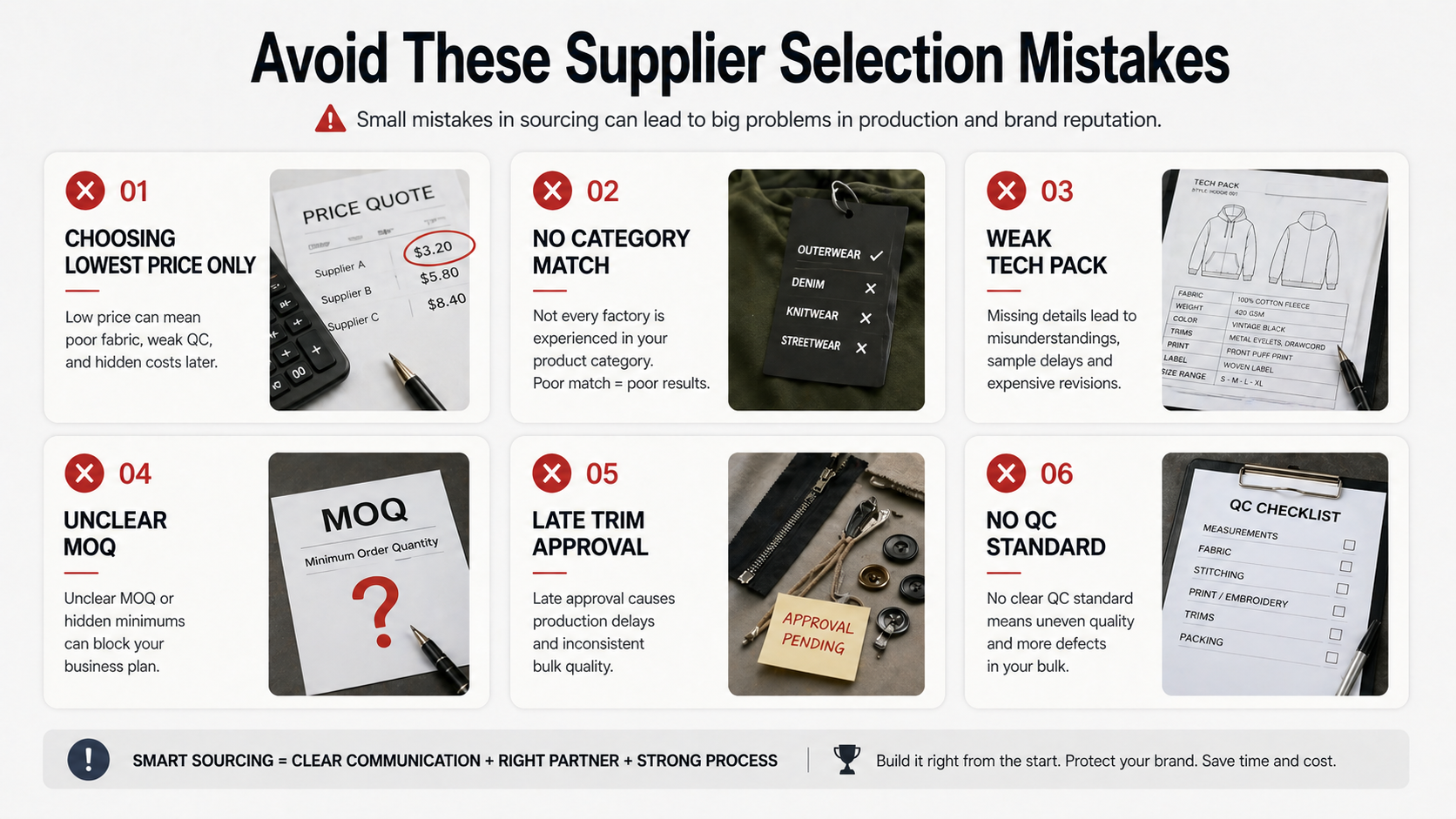
Common Mistakes When Choosing a Streetwear Manufacturer
Most sourcing mistakes happen when brands compare suppliers too narrowly.
Mistake 1: Choosing Only by Lowest Price
The lowest price may exclude better fabric, stronger trims, sample corrections, QC time, or packaging requirements. Brands should compare what is included in the quote before making a decision.
Mistake 2: Asking One Factory to Do Everything Without Checking Category Fit
Some suppliers can support multiple categories, but not every supplier is equally strong in every category. Ask for relevant samples and process details.
Mistake 3: Starting Sampling Without Clear Files
Incomplete files can cause repeated revisions. At minimum, brands should provide reference images, size direction, fabric preference, logo artwork, target quantity, and branding requirements.
Mistake 4: Ignoring MOQ and Scaling Plan
A supplier may be suitable for small testing but not for larger orders. Another supplier may be good for bulk production but not flexible for early-stage revisions. The brand should choose based on current and next-stage needs.
Mistake 5: Treating QC as a Final Step Only
QC should begin before bulk production. Fabric, trims, size chart, sample approval, logo placement, packing method, and inspection points should be confirmed in advance.
Streetwear Manufacturer Evaluation Checklist
Use this checklist before shortlisting a manufacturer.
Capability Checklist
Product category matches your project
Factory understands streetwear fit
Supplier can discuss fabric and trims
Logo techniques are available
Private label support is available
Sample workflow is clear
Bulk production process is clear
QC standards can be discussed
File Checklist
Reference images prepared
Tech pack prepared if available
Size chart prepared
Logo artwork prepared
Color references prepared
Fabric direction prepared
Trim requirements prepared
Packaging requirements prepared
Target quantity prepared
Communication Checklist
Supplier asks detailed questions
Supplier explains missing information
Supplier separates sample and bulk variables
Supplier gives realistic feedback
Supplier discusses risks before production
Supplier confirms approval steps
Supplier can support revision notes
Supplier can align QC points before bulk
Next Steps for Private Label Brands
Before contacting a manufacturer, organize your project into confirmed details and open questions. This makes it easier for the supplier to respond accurately and helps reduce unnecessary back-and-forth.
Prepare These Details First
Product category
Target customer
Reference images
Tech pack or basic measurements
Fabric direction
Color standard
Logo artwork
Trim requirements
Label and packaging needs
Target quantity
Target timeline
QC concerns
How Vanrd Can Support the Evaluation Process
Vanrd works with private label and streetwear buyers that need OEM/ODM development, custom sampling, fabric and trim coordination, bulk production, and quality control. If your brand is comparing manufacturer options, you can send your product brief, references, and development requirements for review.
FAQ
What is the difference between a streetwear manufacturer and a general clothing manufacturer?
A streetwear manufacturer should understand category-specific fit, fabric, trims, branding, and construction details used in streetwear products. A general clothing manufacturer may make basic garments but may not understand oversized fits, heavyweight fleece, washed effects, utility pockets, patches, or streetwear-specific silhouettes.
Should private label brands choose OEM or ODM production?
Private label brands should choose OEM when they already have clear designs, tech packs, size charts, and artwork. ODM may be more suitable when the brand needs development support or wants to modify existing concepts. The decision depends on how much design control the brand wants.
How long does it take to choose a streetwear manufacturer?
The timeline depends on how clear the brand's files are, how many suppliers are compared, how quickly samples are reviewed, and whether fabrics or trims need special sourcing. Brands can move faster when they prepare reference images, tech packs, measurements, artwork, and target quantities before contacting suppliers.
What files should a brand send to a streetwear manufacturer?
A brand should send a tech pack if available, reference images, size chart, fabric direction, color standards, logo artwork, trim requirements, label and packaging details, target quantity, and any QC expectations. If some details are not final, they should be clearly marked as open for discussion.
Is China still a practical sourcing option for private label streetwear?
China can be a practical sourcing option for private label streetwear when the buyer needs fabric sourcing, trims, sampling, OEM/ODM development, and scalable production support. The key is to verify whether the supplier matches the brand's product category, communication needs, MOQ expectations, and QC standards.
Can one manufacturer make hoodies, jackets, pants, and tracksuits together?
Some manufacturers can support multiple categories, but brands should still check each category separately. Hoodies, jackets, pants, tracksuits, denim, and T-shirts have different fabric, pattern, trim, and QC requirements.
What should brands confirm before paying for a sample?
Before paying for a sample, brands should confirm the product category, sample objective, fabric direction, trims, logo method, size chart, sample cost variables, estimated development steps, and what will be reviewed after the sample is finished.
Final CTA
Choosing a streetwear manufacturer in 2026 should be based on product fit, sampling support, material knowledge, trim control, production workflow, and QC standards. A good supplier should help your brand reduce uncertainty before sampling and make bulk production easier to control.
If your brand is developing hoodies, jackets, T-shirts, pants, tracksuits, denim, or other private label streetwear products, send your project brief, tech pack, reference images, and target quantity to Vanrd. Our team can review your requirements and help you plan the next step for sampling and production.
Contact Vanrd through the custom apparel inquiry page to discuss your private label streetwear project.