Tech Pack Guide for Clothing Brands: How to Prepare Designs for Manufacturing
- Share
- publisher
- Vanrd
- Issue Time
- Jul 4,2026
Summary
Learn how to create a professional clothing tech pack for manufacturing. Discover what brands need before production and how VANRD supports apparel development from concept to finished garments.
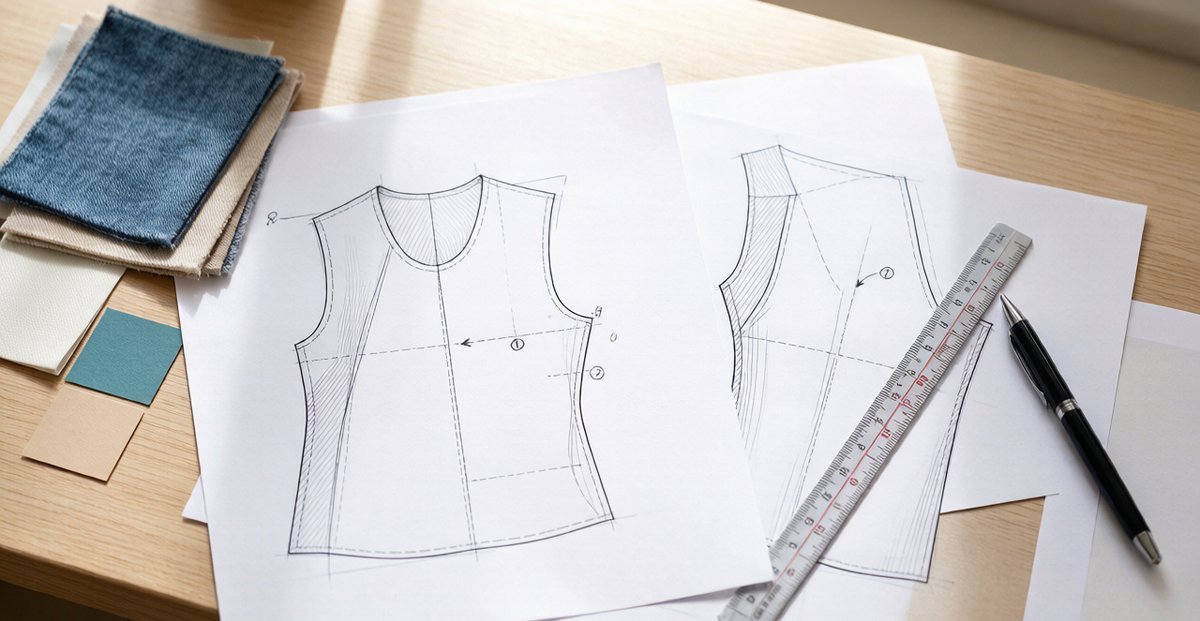
Creating a successful clothing collection requires more than a great design idea. Many fashion brands start with a creative vision, a mood board, or a hand-drawn sketch. However, turning that idea into a finished garment that meets production standards depends on one critical document: a professional clothing tech pack.
A fashion tech pack is the communication bridge between designers, product developers, and manufacturers. It translates creative concepts into technical instructions that clothing factories can follow accurately. Without a detailed tech pack, even the most experienced manufacturers may misunderstand fabric selection, garment measurements, stitching methods, logo placement, or finishing requirements.
For modern clothing brands — especially streetwear brands, private label companies, and designer-led labels — a tech pack works like a construction blueprint. Architects need technical drawings, measurements, and material specifications before building begins. Apparel production follows the same principle: a clear tech pack means fewer sampling revisions, faster production, and consistent quality control.

Professional clothing brands use fashion tech packs to communicate every manufacturing detail before production begins.
At VANRD, an experienced OEM clothing manufacturer, we help brands move from initial concepts to finished garments through professional tech pack review, product development, pattern making, sampling, and large-scale apparel production. This article explains everything you need to know about creating and using a garment tech pack — from the manufacturer's perspective.
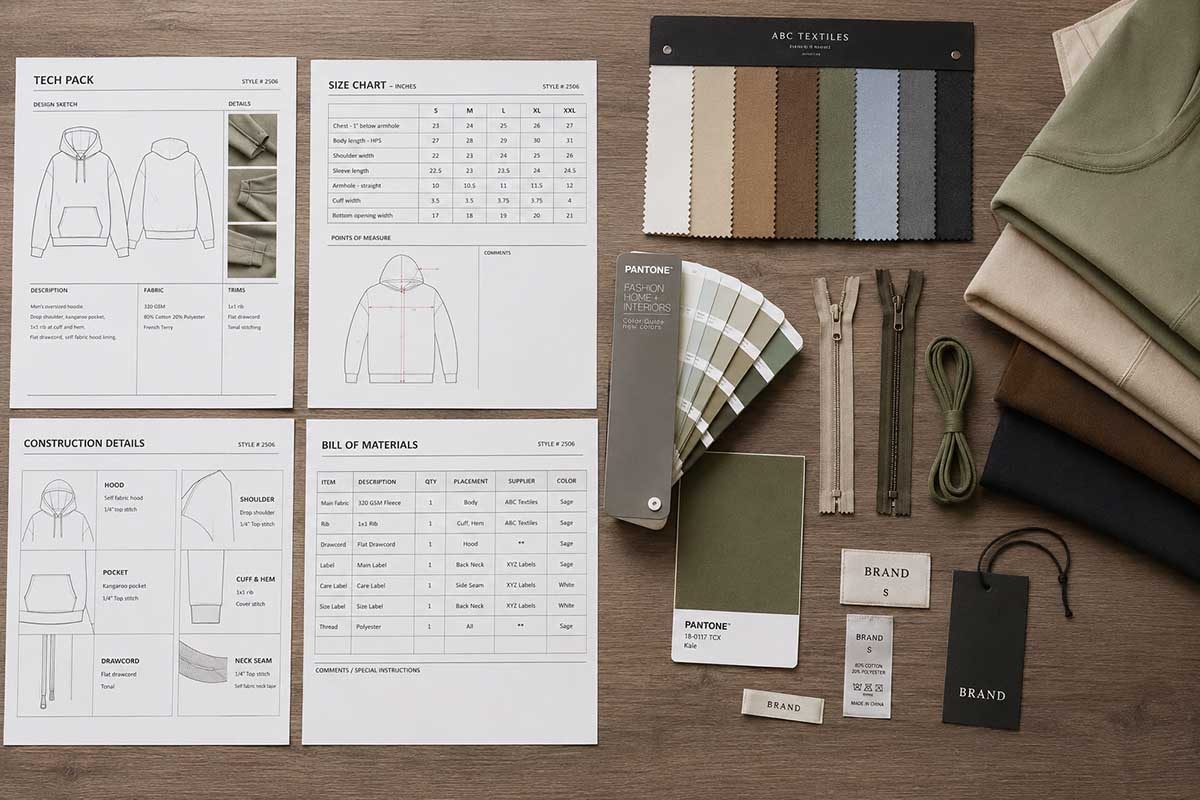
The clothing tech pack development process takes brands from initial concept through technical drawings, fabric selection, measurement specifications, and production preparation.
What Is a Tech Pack in Clothing Manufacturing?
A clothing tech pack (also called an apparel tech pack or garment tech pack) is a detailed production document containing every technical specification required to manufacture a garment correctly.
It connects three critical stages of fashion development:
- The designer's creative idea
- The manufacturer's technical understanding
- The final production garment
Think of a tech pack as the complete production recipe. A fashion sketch shows what a garment should look like, but it does not explain how to manufacture it. For example, a designer may draw an oversized hoodie, but the factory still needs to know:
- What fabric weight should be used? (e.g., 400 GSM cotton fleece)
- Should the hoodie use brushed fleece or French terry?
- How oversized should the fit be? (exact chest and body length measurements)
- Where should the embroidery be placed? (precise coordinates from collar and side seam)
- What stitching method should be applied? (flatlock, overlock, or coverstitch)
- What type of zipper or drawcord should be used? (metal, nylon, custom branded)
A professional tech pack for clothing manufacturers answers these questions in detail before a single piece of fabric is cut. This is why experienced manufacturers consider the tech pack the most important document in the entire clothing production process.
Why Fashion Brands Need a Professional Tech Pack Before Production
Many new clothing brands assume they can simply send product images to a manufacturer and receive identical garments. While reference images are helpful, they are never enough for accurate production.
Manufacturing clothing is like preparing a complex recipe. A photograph of a finished dish shows the appearance, but it does not tell the chef the exact ingredients, quantities, cooking time, or preparation method. A garment tech pack provides manufacturers with the complete recipe for creating your product.
What a Professional Tech Pack Delivers for Your Brand
- Reduce production errors and costly sampling revisions
- Receive more accurate manufacturing quotations upfront
- Create higher-quality first samples with fewer corrections
- Maintain consistent quality across every production cycle
- Shorten the total product development timeline
- Communicate clearly with factories regardless of language barriers
Tech Packs for Different Types of Clothing Brands
Established Brands: Large fashion brands need reliable manufacturing partners who can reproduce consistent quality across thousands of units. A detailed tech pack ensures every production cycle matches the original approved sample — especially important when reordering successful products season after season.
Private Label Clothing Brands: Private label clothing brands need products that represent their own identity. A tech pack defines custom branding requirements including private labels, hang tags, packaging details, logo placement, and special color specifications — allowing manufacturers to create retail-ready products aligned with the brand's market positioning.
Designer-Led and Creator-Led Brands: Designer brands focus heavily on creativity, silhouette, and unique details. However, creative ideas must eventually become technical instructions. A tech pack helps protect original concepts while enabling efficient communication between design and production teams. For brands seeking custom apparel manufacturing that respects design intent, partnering with a manufacturer experienced in designer-led collections is essential.
Better Communication Means Better Pricing
Manufacturers use tech packs to estimate fabric consumption, production difficulty, labor requirements, and material costs accurately. When brands provide complete technical specifications, they receive more precise manufacturing quotes — avoiding unexpected cost increases during production. This also speeds up the entire clothing sample development process, because factories understand requirements from day one.
How Much Should a Tech Pack Cost?
The cost of creating a fashion tech pack depends entirely on product complexity. Simple T-shirts may require basic specification sheets, while complex jackets with multiple panels, linings, and hardware can require extensive technical documentation. Key cost factors include the number of design views, pattern complexity, material types, and artwork requirements.
Many brands choose to work with professional manufacturers who can help review and improve existing tech packs — a service that often saves more money than creating everything from scratch. At VANRD's custom apparel development service, we help brands refine their technical documentation before production begins.
How Tech Packs Help Clothing Manufacturers
From a manufacturer's perspective, a well-prepared tech pack for clothing manufacturers is not just helpful — it is essential for efficient factory operations. When brands invest time in creating accurate technical documentation, the benefits flow directly to the production floor.
1. Reduced Communication Costs and Faster Response Times
Every email exchange to clarify a measurement, confirm a fabric choice, or explain construction details adds days to the development timeline. A complete tech pack eliminates most of these back-and-forth communications. Manufacturers can review the document once, prepare a quotation, and move directly to pattern development — cutting the initial response time from weeks to days. For brands working with streetwear manufacturers or overseas factories, this efficiency gain is especially valuable.
2. Fewer Sampling Rounds and Lower Development Costs
Incomplete tech packs are the leading cause of multiple sampling revisions. When a factory must guess at measurements, fabric weight, or construction methods, the first sample rarely matches the brand's expectations. Each additional sample requires new fabric, labor, and shipping costs — plus lost time. Brands with professional tech packs typically require only 1–2 sampling rounds instead of 3–4, saving hundreds of dollars per style in development costs.
3. Accurate Production Planning and Scheduling
Factory managers use tech packs to plan production capacity, allocate machinery, and schedule operator training. When tech packs arrive late or incomplete, production lines sit idle or must be reconfigured mid-run — causing delays for all customers. Complete documentation allows manufacturers to reserve the right equipment, source materials in advance, and schedule production slots efficiently. This is why experienced OEM clothing manufacturers always request tech packs before confirming delivery timelines.
4. Standardized Quality Control
Quality inspectors rely on tech packs as the objective standard for evaluating finished garments. When the tech pack specifies exact measurements, Pantone colors, stitch types, and trim details, inspectors can verify every parameter against documented requirements — not personal judgment. This standardization reduces disputes between brands and factories, ensures consistent quality across production batches, and creates a clear record for future reorders. Learn more about VANRD's documented quality control procedures.
What Should Be Included in a Clothing Tech Pack?
A complete apparel tech pack needs to cover every detail a manufacturer requires. Missing one category can cause misunderstandings that ripple through the entire clothing production process. Below are the essential components organized from design to finishing.
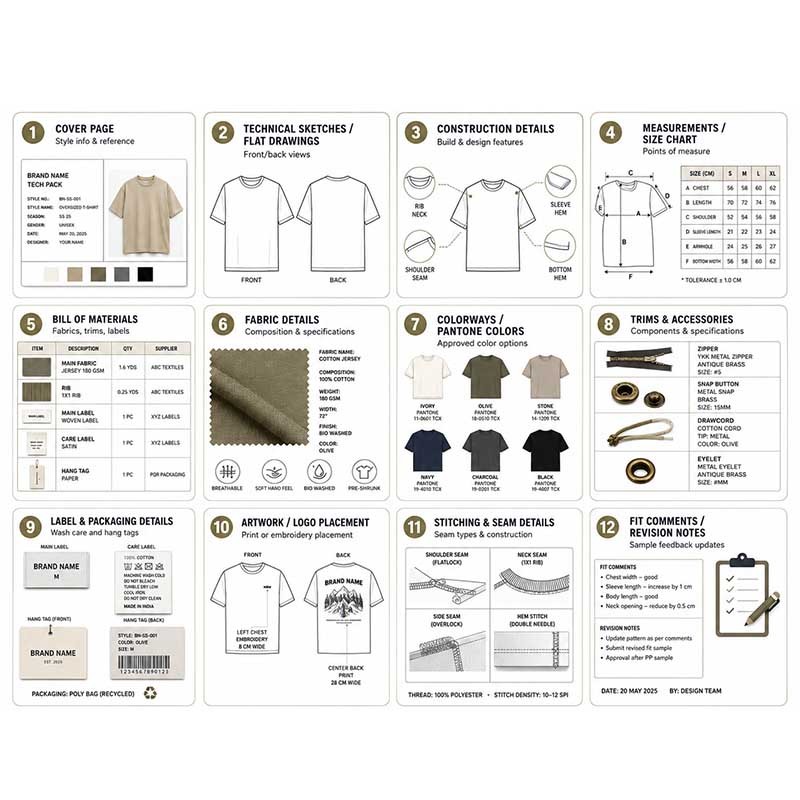
Essential components of a professional clothing tech pack include flat sketches, measurements, fabrics, colors, trims, and construction details.
1. Technical Flat Sketches (Front, Back, and Side Views)
Technical sketches are the most visual part of a tech pack. Unlike fashion illustrations, technical flats focus purely on construction accuracy — showing seam lines, panel divisions, pocket placement, hardware locations, and stitching details. A professional drawing should include front view, back view, side view, and close-up detail drawings for complex areas.
For example: a jacket tech pack should clearly show zipper position, collar construction method, pocket shape and dimensions, and panel design. A hoodie tech pack should define hood shape, kangaroo pocket size, rib construction, and embroidery placement coordinates.
2. Measurement Specification Sheet
The measurement sheet defines the exact garment dimensions and is one of the most common sources of production errors when incomplete. Standard measurements include chest width, shoulder width, sleeve length, body length, waist width, hem opening, and neck opening.
Point of Measurement (POM) Definition: Every measurement must define exactly where on the garment it is taken. Vague instructions like "measure the chest" are not sufficient. A professional apparel tech pack specifies:
- Chest width: Measured 2.5 cm (1 inch) below the armhole, from side seam to side seam, with the garment laid flat. For oversized fits, specify whether the measurement is taken at the widest point or a standard reference position.
- Shoulder slope / drop: Measured from the high point shoulder (HPS) to the armhole seam along the shoulder line. Document whether the shoulder is set-in, dropped, or raglan — each requires different construction.
- Body length: Measured from the high point shoulder (back neck seam center) to the bottom hem. Specify whether this is a center-back measurement or a side-seam measurement — they often differ by 2–3 cm.
- Sleeve length: Measured from the shoulder seam (or underarm seam for raglan) to the cuff edge. For long sleeves, specify whether the measurement is taken from the center back neck over the shoulder to cuff, or along the sleeve seam.
- Neck opening: Measured along the front neck curve from shoulder point to shoulder point. This determines whether a neckline will be tight, relaxed, or wide-neck.
Industry Standard Tolerance Ranges: Every measurement should include an acceptable tolerance range (±). Without tolerances, even minor sewing variation will be treated as a defect. Common industry tolerances for casual and streetwear apparel:
- Chest width: ±1.0 cm
- Body length: ±1.5 cm
- Sleeve length: ±1.0 cm
- Shoulder width: ±1.0 cm
- Neck opening: ±0.5 cm
- Hem width: ±1.0 cm
For streetwear brands, oversized and relaxed fits require especially precise measurement control because proportions define the design identity. Even a 1 cm difference in shoulder drop can change the entire silhouette. When working with VANRD's custom apparel development team, we help brands define exact POM positions and appropriate tolerances for their specific product category and fit requirements.
3. Fabric and Material Specifications
Fabric selection directly determines quality perception, comfort level, and production cost. A complete tech pack must specify fabric composition (e.g., 100% cotton, 80/20 cotton-polyester), weight (GSM), texture, stretch level, washing requirements, and performance expectations.
Examples of how fabric choice changes the product: a heavyweight streetwear hoodie may require 400 GSM cotton fleece; a lightweight windbreaker needs nylon or polyester shell fabric; a premium T-shirt demands combed cotton with a soft hand feel. Learn more about VANRD's custom apparel development and material sourcing support.
4. Color Specifications and Standards
Color is one of the first things customers notice. However, describing colors with words like "dark green" or "vintage blue" creates misunderstandings during production. A professional tech pack should reference Pantone color codes, fabric color swatches, and digital color references — enabling manufacturers to achieve consistent color matching between samples and bulk production.
5. Trims, Labels, and Hardware
Trims and accessories define the final quality perception. A complete tech pack specifies zippers (type, length, color, branded pullers), buttons, snaps, drawcords, custom labels, hang tags, and packaging materials. For example, a premium bomber jacket may require custom metal zippers and branded hardware, while a streetwear hoodie needs oversized drawcords with metal eyelets.
6. Printing, Embroidery, and Decoration
Artwork placement and decoration methods require precise instructions. The tech pack should define artwork position (with measurements from reference points), artwork dimensions, printing method (screen printing, DTG, puff print, heat transfer), thread colors for embroidery, and any special effects. VANRD provides professional custom embroidery and garment decoration solutions for brands creating distinctive apparel products.
7. Special Fabric Treatments and Construction Techniques
Beyond basic decoration, many modern streetwear and outerwear products require specialized fabric treatments and construction methods that must be clearly documented in the tech pack. Omitting these details is a common reason why samples do not match brand expectations.
Garment Washing and Dye Techniques: Heavyweight streetwear frequently uses specialized washes to achieve vintage or distressed aesthetics. Your tech pack should specify the exact wash method: acid wash (for marbled color effects), vintage wash (for soft, worn-in appearance), enzyme wash (for bio-polishing and surface smoothing), or garment dye (for post-construction coloring). Each method requires different preparation, temperature settings, and chemical formulations — and produces distinctly different results.
Printing Method Specifications: Not all printing methods work on all fabrics. A tech pack for clothing manufacturers should specify the exact printing technique with material compatibility notes:
- Screen printing: Best for bold, opaque designs on cotton and cotton-blend fabrics. Specify mesh count, ink type (plastisol, water-based, discharge), number of colors, and flash curing requirements.
- Direct-to-garment (DTG): Ideal for photorealistic, multi-color designs on 100% cotton or high-cotton blends. Specify pretreatment requirements, resolution expectations, and color profile settings.
- Puff print / High-density print: Creates raised, textured effects. Specify ink thickness, curing temperature, and the exact dimensional height of the raised area.
- Sublimation printing: Used on polyester-based fabrics. Requires white base fabric or a dedicated sublimation-compatible material layer.
Technical Outerwear Construction: Jackets, technical shells, and performance outerwear require additional construction specifications that basic apparel tech packs often miss. Seam sealing / taping should specify tape width, application temperature, and seam types that require waterproof treatment. Inner lining structures must document quilted patterns, mesh ventilation panels, insulation placement, and interior pocket construction. Zipper and hardware waterproofing should note whether YKK Aquaguard zippers, storm flaps, or bonded seams are required for weather resistance.
Tech Pack Requirements by Clothing Category
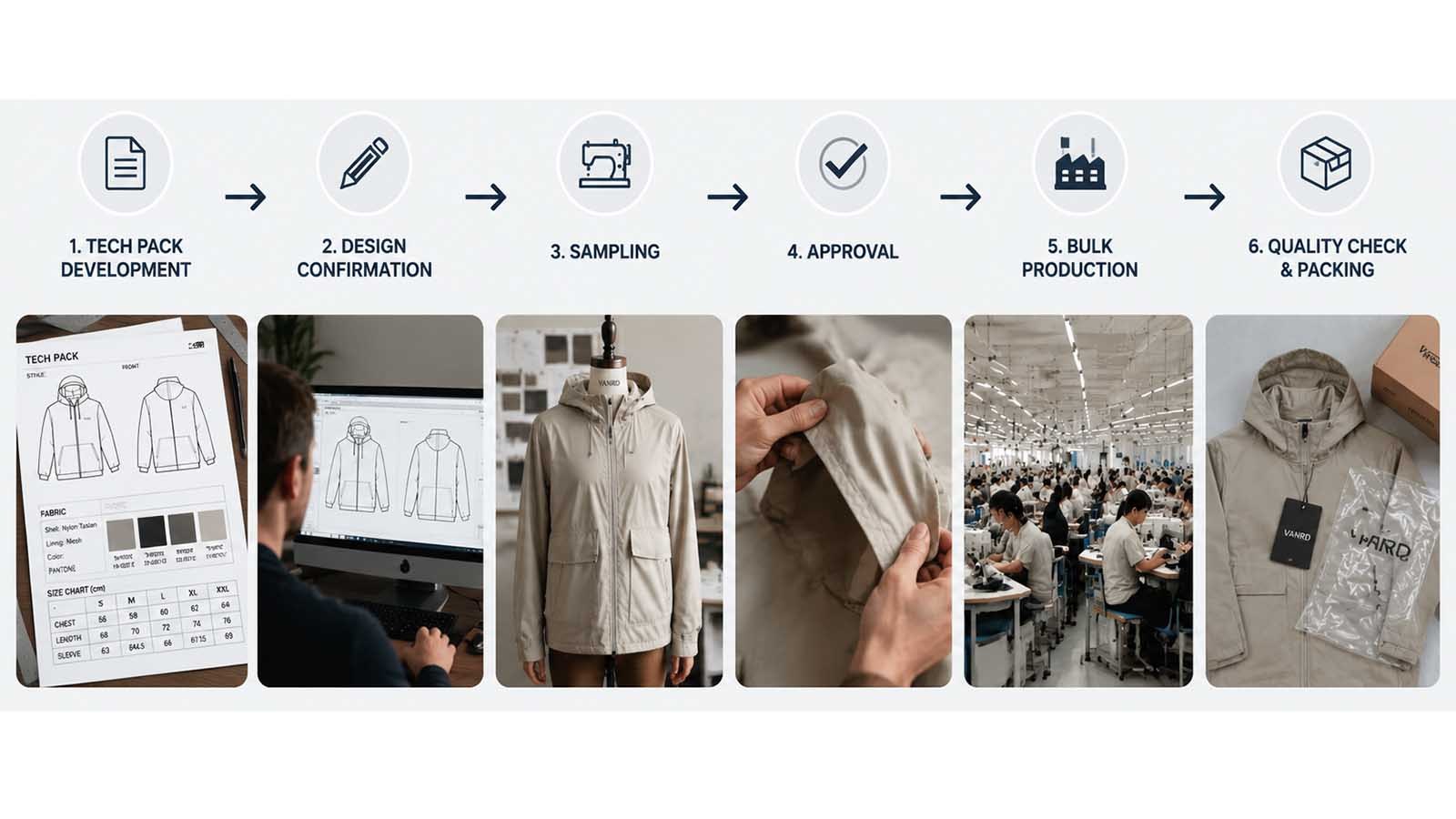
Custom streetwear apparel manufacturing requires detailed tech packs to ensure every garment meets brand specifications for fit, fabric, finish, and decoration.
Different product types require different levels of technical detail. Hoodies and sweatshirts need fabric weight, hood construction, rib specs, and pocket dimensions. Jackets and outerwear require more information: outer shell fabric, lining material, insulation, multiple zipper types, and hardware finishing. For specialized jacket manufacturing, learn about VANRD's custom jacket development capabilities. Premium hoodie brands can explore our custom hoodie manufacturing services. T-shirts and basic tops may seem simple, but even a basic tee requires precise neckline construction, shoulder drop, and hem width specifications — explore VANRD's custom T-shirt manufacturing for details.
How Manufacturers Use Tech Packs During Production
Understanding how a factory actually processes your tech pack for clothing manufacturers helps you create better documentation. At professional manufacturing facilities, the tech pack is not reviewed once — it is referenced at every stage of production.

Manufacturers review tech packs before pattern development, fabric sourcing, sampling, and bulk production.
Step 1: Technical Review and Feasibility Assessment
The production team first reviews the tech pack to assess whether the design can be manufactured efficiently. They check fabric requirements against available materials, evaluate construction complexity, identify any potential production challenges, and determine whether special machinery or techniques are required. If issues are found at this stage, the team communicates with the brand before any cutting begins — saving time and material costs.
Step 2: Pattern Development and Grading
Pattern makers create the garment pattern based on tech pack measurements. This is where fit and proportion are defined. The pattern determines the final shape of every panel, and grading rules expand the base size into a complete size range (S–XXL). Experienced pattern makers can identify measurement inconsistencies in the tech pack and suggest corrections before sampling.
Step 3: Material Sourcing and Preparation
Based on the fabric specifications in the tech pack, the sourcing team procures main fabrics, lining materials, interlinings, and all specified trims. Color matching against Pantone references and lab dip approvals happen during this phase.
Step 4: Sample Development
The first sample is created according to the complete tech pack. Brands evaluate fit, fabric hand feel, color accuracy, construction quality, and artwork placement. A detailed tech pack typically results in fewer sampling rounds — often reducing the process from 3–4 iterations to just 1–2.
Step 5: Production Quality Control
Once the sample is approved, the tech pack becomes the production reference document. The quality control team uses it to inspect every production stage: cutting accuracy, sewing quality, trim attachment, decoration placement, and final garment measurements. Every piece is checked against the original tech pack specifications to ensure consistent quality across the entire production run.
VANRD Production Process: From Tech Pack to Finished Garment
At VANRD, every production order follows a structured workflow designed to transform your apparel tech pack into a finished, retail-ready garment. Understanding this process helps brands know what to expect at each stage and how to prepare accordingly.
Phase 1: Tech Pack Review & Feasibility Analysis (2–3 Days)
Our production team reviews your complete tech pack to assess technical feasibility, identify potential manufacturing challenges, and confirm material availability. We provide feedback on any specifications that may need adjustment for production efficiency — such as seam types, construction sequences, or fabric alternatives that achieve the same result at lower cost.
Phase 2: Pattern Development & Grading (5–7 Days)
Our pattern makers create the master pattern based on your tech pack measurements, then grade it across your full size range. During this phase, we verify measurement consistency, check for potential fit issues, and confirm that the pattern matches your design intent before any fabric is cut.
Phase 3: Material Sourcing & Lab Dip Approval (5–10 Days)
Using your fabric specifications, we source main materials, linings, interlinings, and all specified trims from our supplier network. Color lab dips are submitted for approval against your Pantone references or physical swatches. Only after material approval do we proceed to sampling.
Phase 4: Sample Development & Fit Approval (10–15 Days)
The first pre-production sample is created according to the approved tech pack and pattern. Brands evaluate fit, fabric hand feel, color accuracy, construction quality, and artwork placement. Most tech packs with complete specifications require only 1–2 sampling rounds. For brands requiring professional clothing sample development, we provide detailed revision tracking and photo documentation at every stage.
Phase 5: Bulk Production & Quality Inspection (25–35 Days)
After sample approval, production begins with inline quality checks at cutting, sewing, and finishing stages. Our QC team inspects every batch against the tech pack specifications, measuring key points, checking color consistency, and verifying trim placement. Final inspection occurs before packaging and shipping. Learn more about VANRD's quality control standards and inspection process.
Phase 6: Packaging, Labeling & Shipping (3–5 Days)
Finished garments receive custom labels, hang tags, and branded packaging according to your tech pack requirements. We prepare shipping documentation, arrange logistics, and deliver your order to the specified destination — completing the journey from technical document to retail-ready product.
Common Tech Pack Mistakes That Cause Manufacturing Problems
Even experienced brands sometimes make technical documentation errors that lead to production issues. Understanding these common mistakes helps you create better garment tech packs and avoid costly corrections.
Mistake 1: Providing Only Images Without Technical Specifications
Product images show appearance, not construction. Manufacturers need technical instructions to understand seam types, stitch density, internal construction, and finishing methods. Without these details, the factory must make assumptions — and assumptions lead to incorrect samples.
Mistake 2: Missing or Incomplete Measurement Charts
Incorrect measurements are the number one cause of poor-fitting garments. Common issues include missing key measurement points, inconsistent grading between sizes, and measurements that do not account for fabric stretch or shrinkage. Always include tolerance ranges (±) for each measurement point.
Mistake 3: Unclear Fabric and Material Details
Saying "cotton fabric" is not enough. Manufacturers need composition percentages, weight (GSM), construction type (jersey, fleece, twill), and any special treatments. A hoodie made with 280 GSM fleece will feel completely different from one made with 400 GSM fleece — even if the design is identical.
Mistake 4: Undefined Quality Standards and Inspection Criteria
Brands should clearly communicate their quality expectations, including acceptable defect rates (AQL standards), sewing quality requirements, packaging specifications, and finishing standards. Without defined criteria, the manufacturer's quality interpretation may differ from the brand's expectations.
Real-World Case Study: Before & After Tech Pack Quality
To understand why a detailed clothing tech pack matters, consider a real scenario we have encountered at VANRD. A streetwear brand sent us a product image of a vintage-washed hoodie they wanted to produce — but nothing else.
❌ Before: Incomplete Tech Pack
What the brand provided:
- One reference photo with shadow effects and model pose
- Text description: "oversized vintage washed hoodie, dark grey"
- No measurements, no fabric specs, no wash instructions
Result: First sample had incorrect body proportions (too short), wrong fabric weight (too light), color mismatch (looked blue-grey instead of charcoal), and an unapproved vintage wash intensity. Required 3 sampling rounds and added 4 weeks to the timeline.
✅ After: Complete Tech Pack
What the brand provided:
- Technical flat sketches (front, back, side views with seam lines)
- Complete measurement chart with 12 POM points and ±1.0 cm tolerances
- Fabric spec: 400 GSM cotton fleece, enzyme-washed, brushed interior
- Pantone color reference: 19-3911 TCX (Dark Slate)
- Vintage wash instruction: light enzyme wash, 30-minute cycle, no pumice stones
- Embroidery artwork with exact placement coordinates
Result: First sample matched specifications within tolerance on all measurement points. Color and wash effect matched the reference. Only minor embroidery thread color adjustment needed. Approved on the second sample — saving 3 weeks and approximately $400 in development costs.
Can Clothing Manufacturers Create Tech Packs?
One of the most common questions we receive from new clothing brands is whether manufacturers can help create tech packs. The answer is yes — and this is a significant advantage of working with an experienced OEM and ODM clothing manufacturer.
ODM Product Development: From Idea to Tech Pack
Many brands come to VANRD with design concepts, mood boards, or reference garments rather than complete technical documentation. Our product development team transforms these creative inputs into professional apparel tech packs that include:
- Professional technical flat sketches (front, back, side views)
- Complete measurement specification sheets with grading
- Fabric and material recommendations based on product positioning
- Color standards and trim specifications
- Construction and stitching instructions optimized for production efficiency
This ODM (Original Design Manufacturing) approach is especially valuable for brands that have strong creative vision but limited technical experience in garment construction. The manufacturer's production knowledge is applied at the design stage — preventing manufacturing problems before they occur.
When Should Brands Create Their Own Tech Packs?
Established brands with in-house design teams often prefer creating their own tech packs to maintain complete creative control. Experienced designers who understand pattern making and garment construction can produce highly accurate technical documentation independently.
However, even professional tech packs benefit from a manufacturer's technical review. A factory's production team can identify practical issues that may not be obvious during design — such as stitching methods that work better for specific fabrics, or construction sequences that improve efficiency. At VANRD, we provide free tech pack review as part of our product development service.
Tech Pack vs Sample: What Is The Difference?
Many new brands confuse tech packs with physical samples, but they serve completely different purposes in the clothing production process. Understanding this distinction helps you communicate more effectively with manufacturers.
| Aspect | Clothing Tech Pack | Physical Sample |
|---|---|---|
| Purpose | Provides technical instructions for manufacturing | Shows the actual finished product result |
| Format | Digital document (PDF, AI, Excel) | Physical garment |
| When Created | Before production begins | After pattern development, during sampling |
| What It Shows | How the garment should be built (measurements, seams, materials) | How the garment looks and feels when worn |
| Used By | Pattern makers, cutting team, sewing operators, QC inspectors | Designers, buyers, marketing teams |
| Role in Production | The instruction manual — required at every production stage | The quality benchmark — the approved reference for bulk production |
In practice, the tech pack and sample work together. The tech pack guides sample creation; the approved sample then becomes the physical reference standard. If there is ever a conflict between the tech pack and the sample, manufacturers should clarify with the brand before proceeding — this is a standard part of professional clothing sample development.
How VANRD Helps Brands From Design To Production
A great tech pack starts the product development journey, but choosing the right manufacturing partner determines the final result. At VANRD, we support clothing brands through every stage of the apparel production process — whether you arrive with a complete tech pack or just an initial product concept.
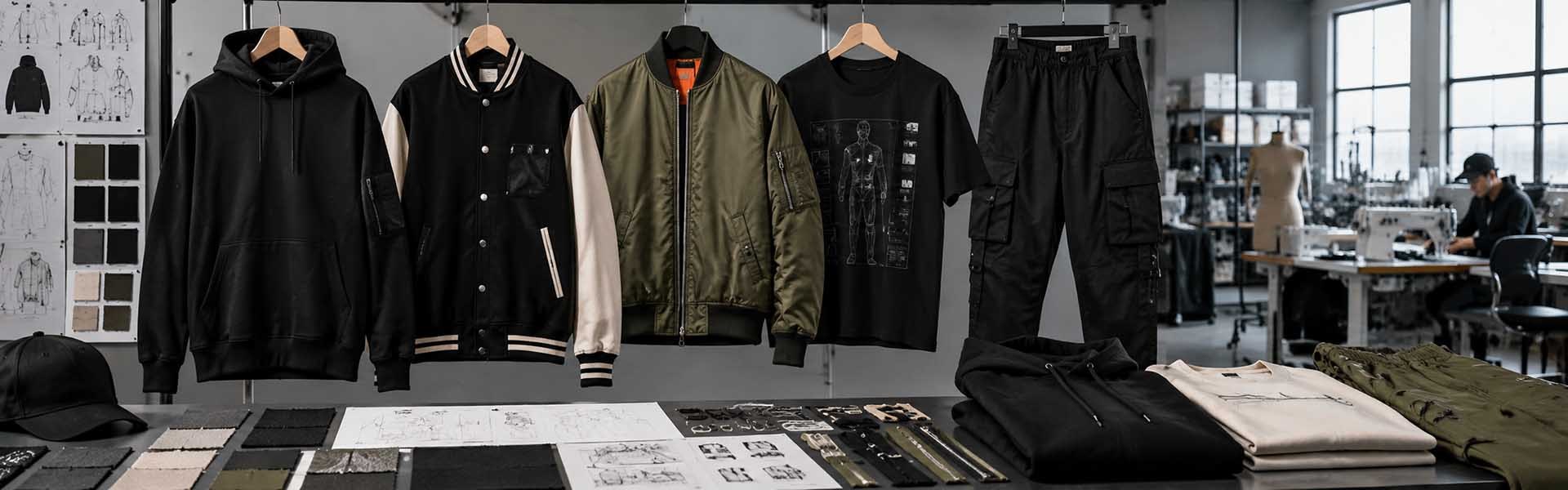
The VANRD apparel product development team helps clothing brands transform tech packs into production-ready garments through professional manufacturing support.
Complete Manufacturing Services for Clothing Brands
- Tech Pack Review & Optimization: Our production team reviews your technical documentation, identifies potential issues, and suggests improvements before cutting begins.
- ODM Product Development: Transform your design concepts and mood boards into complete, production-ready clothing tech packs.
- Fabric & Material Sourcing: Access our network of fabric suppliers to find the right materials for your product positioning and budget.
- Pattern Development & Grading: Professional pattern making with full size grading to ensure consistent fit across your entire collection.
- Sampling & Fit Approval: Receive physical samples for evaluation, with clear revision tracking and timeline management.
- Custom Branding: Custom labels, hang tags, packaging, and garment decoration — embroidery, screen printing, puff printing, and more.
- Quality Control & Inspection: Multi-stage quality inspection during and after production, following our documented QC procedures.
- Bulk Production & Logistics: Reliable manufacturing with consistent quality across your entire order, plus shipping and logistics support.
Final Checklist Before Sending Your Tech Pack
- Complete technical drawings (front, back, side, detail views)
- Accurate measurement chart with tolerance ranges
- Fabric specifications (composition, weight, construction type)
- Color references (Pantone codes or physical swatches)
- Trim and hardware details (type, size, color, finish)
- Artwork files with placement instructions
- Packaging and labeling requirements
- Quality standards and inspection criteria
Ready to Start Your Clothing Production?
Whether you have a complete tech pack ready for review or just an initial product idea, VANRD's product development team can help transform your concept into a production-ready garment.
As an experienced OEM and ODM clothing manufacturer, we support established brands, private label companies, designer labels, and creator-led clothing brands with professional development, sampling, and manufacturing services.
Conclusion: A Professional Tech Pack Transforms Ideas Into Products
A successful clothing collection begins with creative vision, but professional manufacturing demands clear technical communication. A detailed clothing tech pack transforms your design ideas into precise manufacturing instructions that factories can follow accurately — reducing errors, shortening timelines, and protecting your brand's quality standards.
For fashion brands that want consistent quality, faster product development, and fewer production problems, investing in a professional apparel tech pack is one of the highest-ROI decisions you can make. The cost of a well-prepared tech pack is almost always less than the cost of correcting a single round of sampling errors. Ready to get started? Contact VANRD's product development team for a free tech pack review and manufacturing consultation.
Whether you are launching your first clothing line, expanding an existing collection, or scaling up production volumes, a strong tech pack creates the foundation for reliable, repeatable garment manufacturing. Combined with an experienced manufacturing partner who understands your product category, a professional tech pack is the difference between hoping for good results and being confident you will get them.
Frequently Asked Questions About Clothing Tech Packs
1. What is the difference between a tech pack and a fashion sketch?
A fashion sketch focuses on creative visual presentation. A tech pack provides the technical instructions required for manufacturing — including measurements, material specifications, construction methods, and quality standards.
2. Do clothing manufacturers require a tech pack?
Professional clothing manufacturers strongly recommend tech packs because they eliminate guesswork, reduce misunderstandings, and help create accurate samples on the first attempt. Some manufacturers, including VANRD, can also help create tech packs through ODM development services.
3. Can clothing brands create their own tech packs without technical experience?
Yes, beginners can create basic tech packs using templates and software tools. However, working with an experienced manufacturer for technical review helps identify potential production issues early — saving significant time and cost during sampling.
4. How many pages should a clothing tech pack include?
The length depends entirely on product complexity. A simple T-shirt tech pack may be 2–3 pages, while a detailed jacket or technical outerwear tech pack can run 15+ pages. The key principle is completeness, not page count: every manufacturing detail must be documented.
5. Can a manufacturer improve an existing tech pack?
Yes. Experienced clothing manufacturers can review your tech pack, identify areas for improvement, and suggest adjustments for better production efficiency and quality. At VANRD, tech pack review is included as part of our product development service before any manufacturing begins.
6. What if I only have a design idea and no tech pack?
Many brands start with just ideas, mood boards, or reference garments. VANRD's ODM product development team can transform creative concepts into complete, production-ready tech packs — handling technical sketches, measurements, fabric selection, and all manufacturing specifications.
7. Can I create a tech pack without design experience?
Yes. Beginners can create basic tech packs using templates and software tools. However, working with an experienced manufacturer for technical review helps identify potential production issues early — saving significant time and cost during sampling. At VANRD, we provide free tech pack review as part of our product development service, helping brands refine their documentation before production begins.
8. If I already have a physical sample, do I still need a tech pack?
Yes. A physical sample shows how the garment looks and feels, but it does not contain the technical instructions required for bulk production. Factories need precise measurements, fabric specifications, construction details, and quality standards — all documented in a garment tech pack — to reproduce the sample accurately at scale. The sample and tech pack work together: the sample is the quality benchmark, and the tech pack is the instruction manual. Without the tech pack, manufacturers must reverse-engineer the sample, which increases cost and error risk.
9. How long does it take to create a qualified tech pack?
For a simple product like a T-shirt, an experienced designer can create a complete tech pack in 2–4 hours. Complex products like technical jackets or multi-panel outerwear may require 8–15 hours or more. Brands working with VANRD's ODM development team can receive a production-ready tech pack within 5–7 business days, including technical sketches, measurements, fabric recommendations, and construction details. The time investment in creating a thorough tech pack is almost always recovered through faster sampling and fewer production errors.
Tech Pack Readiness Checklist: Is Your Tech Pack Production-Ready?
Before sending your clothing tech pack to a manufacturer, use this checklist to verify completeness. If you check fewer than 7 items, your documentation likely needs additional detail before production can begin efficiently.
✓ Tech Pack Completeness Checklist
Review each item and confirm it is included in your tech pack:
- Technical flat sketches — front, back, and side views with all seams and construction lines visible
- Complete POM measurement chart — with exact measurement points, base size values, and tolerance ranges (±)
- Fabric specifications — composition percentages, GSM weight, construction type (jersey, fleece, twill), and any special treatments
- Color standards — Pantone TPX/TCX codes or physical swatch references for every colorway
- Trim and hardware details — zipper type/length/color, button specifications, drawcord details, label placement
- Artwork and decoration specs — print/embroidery placement coordinates, dimensions, color separations, and method (screen print, DTG, embroidery)
- Special treatments documented — wash methods (acid wash, enzyme wash, vintage wash), seam sealing, or other finishing requirements
- Label and care instruction details — main label, size label, care label content, and exact placement positions
- Packaging specifications — polybag type, hang tag design, folding method, and carton packing requirements
- Quality standards defined — AQL level, acceptable defect types, measurement inspection criteria, and finishing requirements
⚠️ Less Than 7 Items Checked?
If your tech pack is missing more than 3 items from this checklist, your manufacturer will likely need to request clarifications before production can begin — adding days or weeks to your timeline.
Contact VANRD for a free tech pack review → Our design team will identify missing elements and help you complete your documentation before sending it to production.
Start Your Clothing Production With VANRD
Whether you have a complete tech pack ready for manufacturing review or just a design concept that needs technical development, our team is here to help. Get a free tech pack assessment and production quote within 48 hours.
What you get: Free tech pack review + material recommendations + production timeline + transparent pricing.