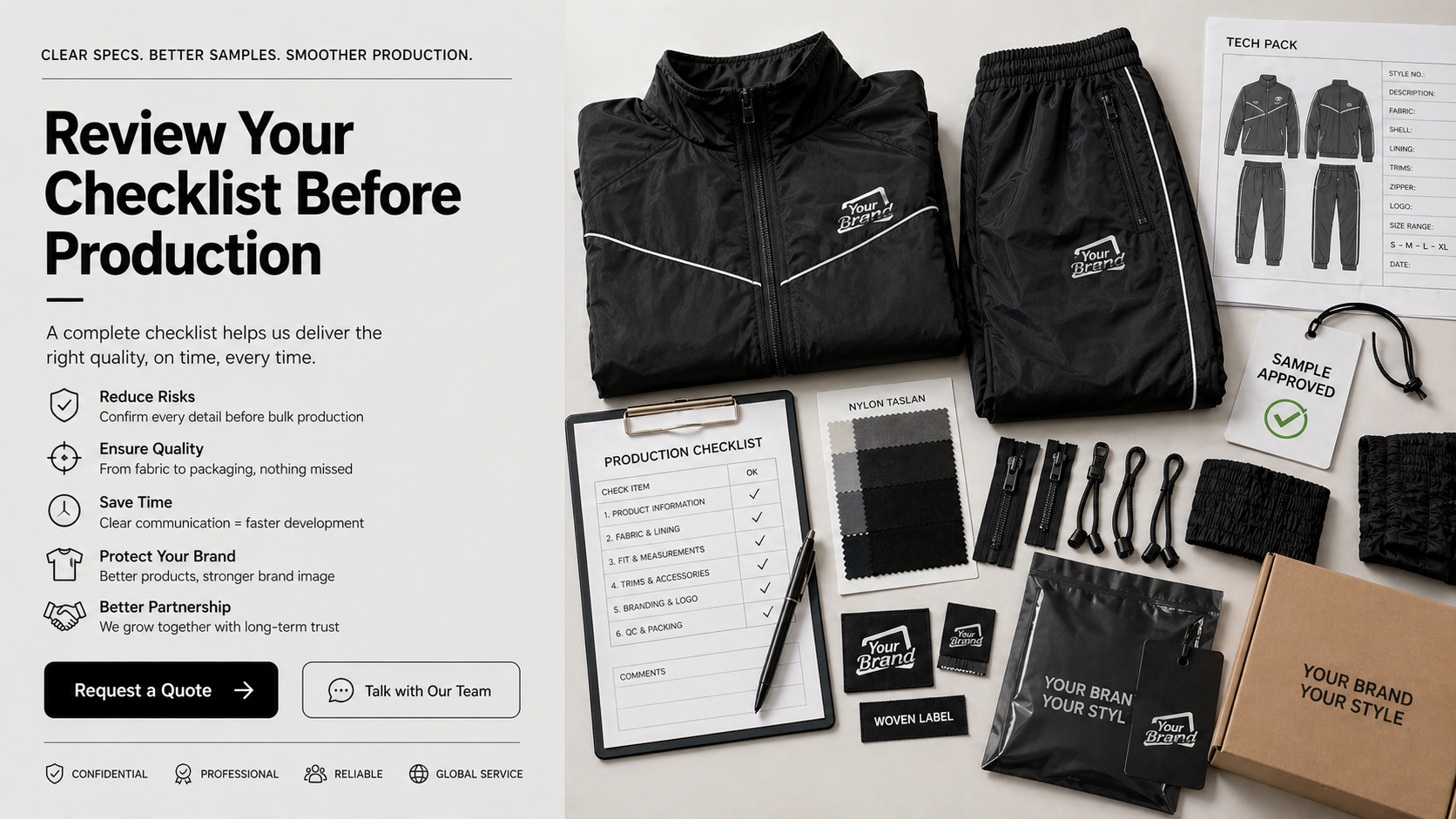
Nylon Tracksuit Manufacturing Checklist: Fabric, Fit, Trims, and QC Points
- Share
- publisher
- Vanrd
- Issue Time
- Apr 16,2026
Summary
A practical B2B manufacturing checklist for clothing brands developing custom nylon tracksuits. Learn what to check before production, including fabric, fit, lining, trims, branding, sample approval, QC points, and bulk production risks.
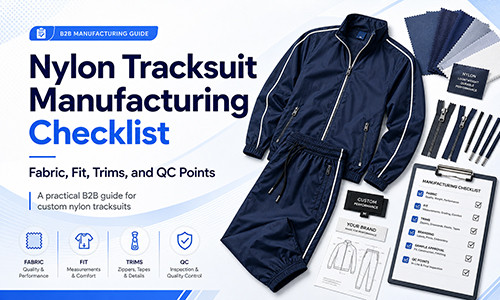
A nylon tracksuit manufacturing checklist helps clothing brands confirm fabric, fit, trims, branding, construction, and QC points before bulk production. The goal is to reduce unclear specifications, sample revisions, and production risks.
For private label brands, the most important checks include nylon fabric type, lining, garment measurements, zipper quality, waistband recovery, logo compatibility, seam smoothness, color consistency, and final approval standards. A clear checklist makes supplier communication more accurate and production planning more controlled.
Quick Answers
What should be included in a nylon tracksuit manufacturing checklist?
A nylon tracksuit checklist should include fabric type, fabric weight, lining, fit, size chart, zipper quality, pockets, waistband, cuffs, branding method, label placement, seam quality, measurement tolerance, color approval, packaging, and QC standards.
Why is a checklist important before nylon tracksuit production?
A checklist helps buyers and manufacturers confirm important details before bulk production. It reduces the risk of fabric mismatch, poor fit, trim issues, logo errors, unclear measurements, and delayed approvals.
What fabric points should be checked for nylon tracksuits?
Buyers should check nylon fabric weight, hand feel, surface finish, coating, stretch, color, lining compatibility, noise during movement, seam behavior, and branding compatibility.
What fit points matter most for nylon tracksuits?
Important fit points include jacket shoulder width, chest ease, sleeve length, hem shape, pants waist, rise, thigh width, inseam, ankle opening, waistband recovery, and the balance between jacket and pants.
What QC points should be checked before bulk shipment?
QC should check fabric color, seam smoothness, zipper function, pocket symmetry, waistband recovery, cuff tension, logo placement, measurement tolerance, lining comfort, label accuracy, and packaging condition.
What files should brands send before manufacturing nylon tracksuits?
Brands should send a tech pack, size chart, reference images, fabric direction, color standard, logo artwork, trim details, label placement, packaging requirements, order quantity, and QC requirements.
Why Nylon Tracksuit Manufacturing Needs a Clear Checklist
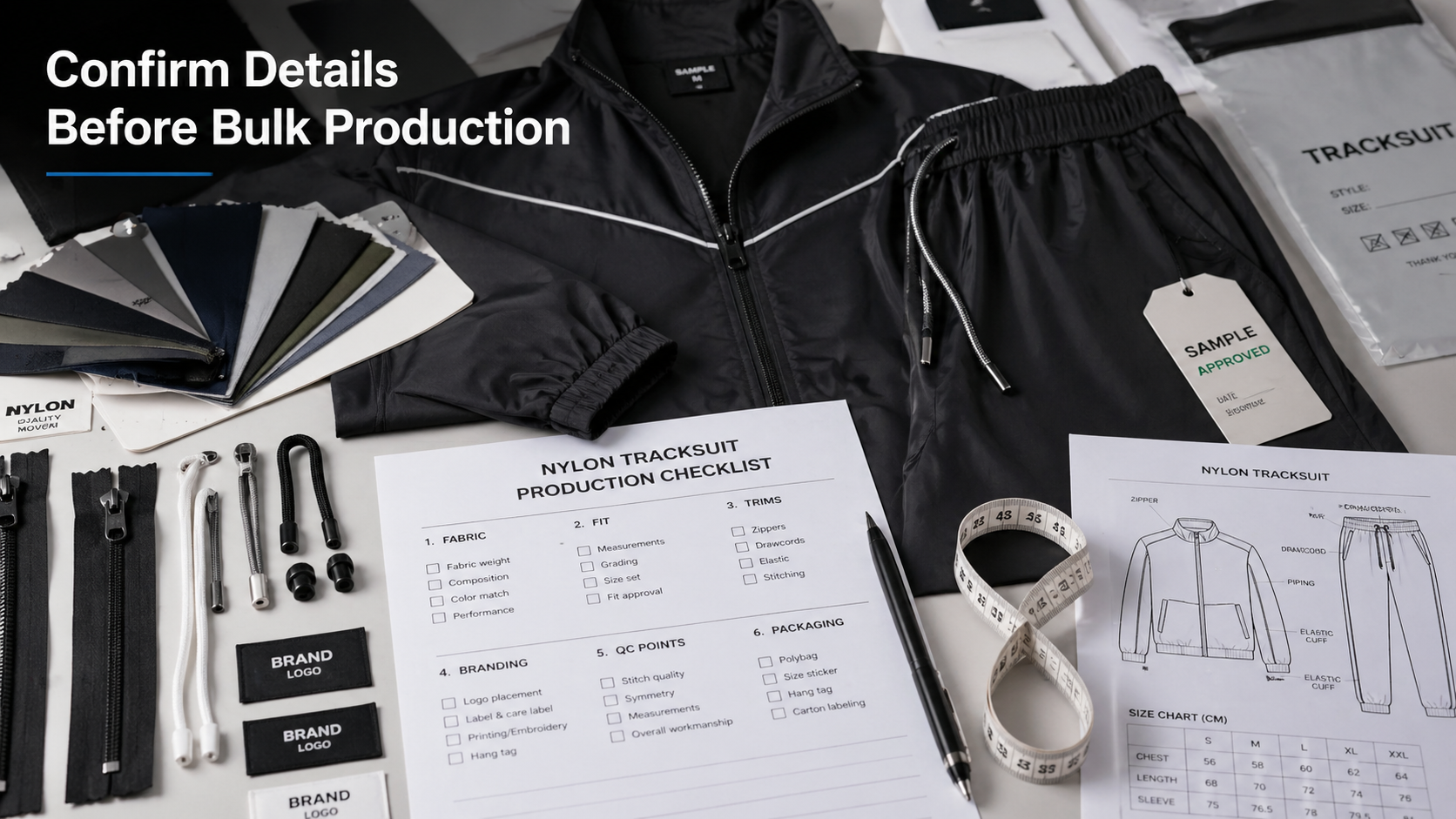
Nylon tracksuit manufacturing needs a clear checklist because fabric behavior, fit balance, trims, branding, and QC standards all affect the final product. A tracksuit may look simple, but production details can quickly become complex when the garment includes lining, zippers, elastic, pockets, prints, embroidery, patches, or custom labels.
For clothing brands, the checklist is not only an internal document. It is also a communication tool between the buyer and the manufacturer. It helps both sides confirm what has been approved, what still needs testing, and what must be controlled during bulk production.
A weak checklist can lead to common production problems: wrong fabric hand feel, inconsistent color, poor zipper function, loose waistband, incorrect logo placement, size tolerance issues, or unclear packaging standards.
Vanrd supports private label and OEM/ODM custom apparel development for brands that need sampling, fabric selection, production planning, and quality control support. Buyers can review Vanrd's OEM/ODM Services to understand how custom development is normally planned.
Checklist Area 1: Fabric Selection and Fabric Approval
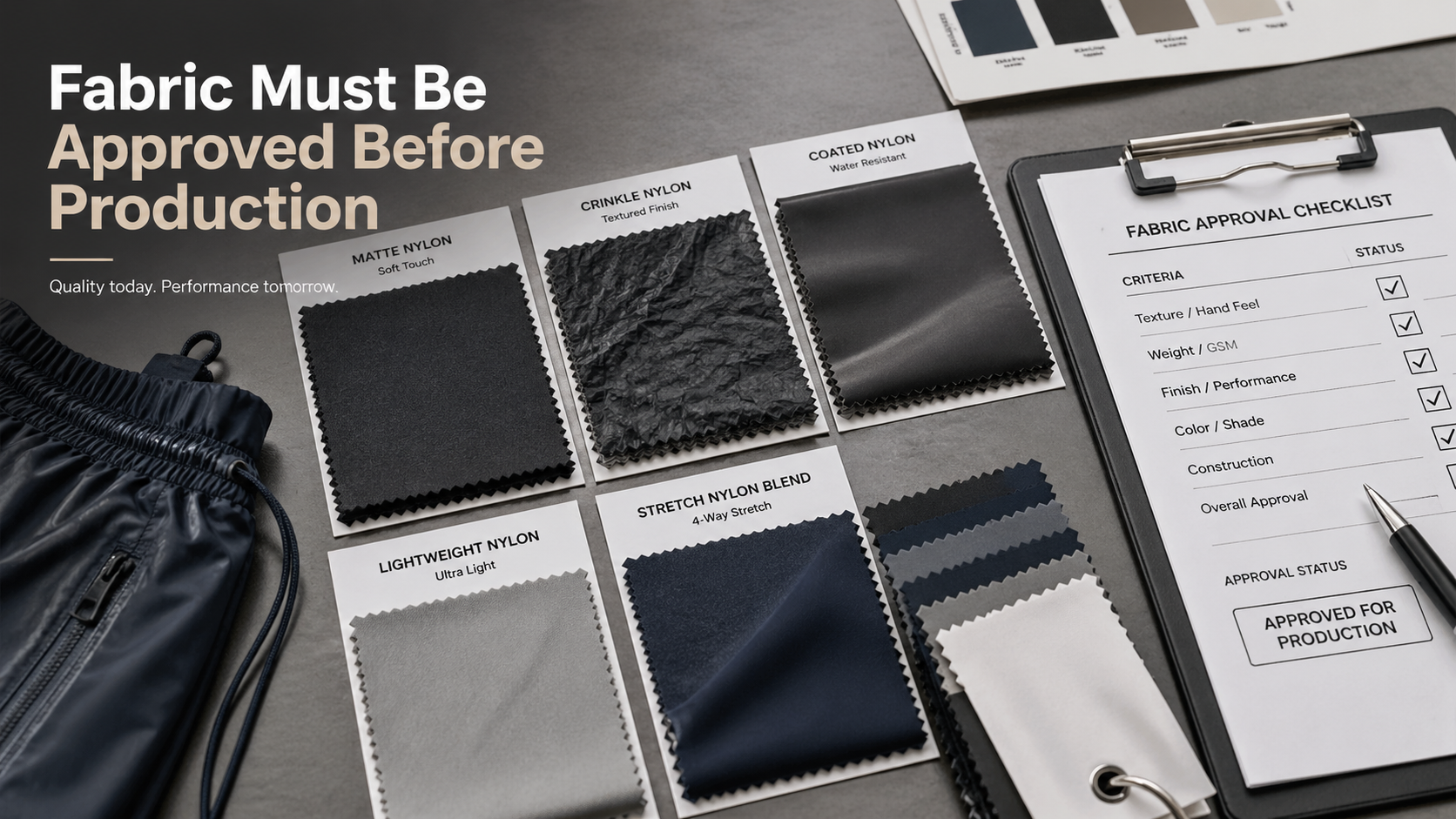
Fabric is the first major checkpoint in nylon tracksuit manufacturing. The buyer should confirm not only the fiber name, but also the exact fabric behavior and production suitability.
Fabric Points to Check
Before approving fabric, check:
1.Nylon fabric type
2.Fabric weight or thickness direction
3.Hand feel
4.Surface finish
5.Matte, shiny, crinkle, coated, or smooth effect
6.Stretch level if required
7.Color standard
8.Lining compatibility
9.Breathability expectation
10.Noise during movement
11.Seam behavior
12.Logo compatibility
13.Bulk fabric availability
The term "tracksuit nylon" is too broad for production approval. A manufacturer needs a more specific fabric direction to build a stable sample and control bulk production.
Fabric Approval Questions
Buyers should ask:
Does the fabric match the intended product use?
Does the fabric support the target fit?
Does the surface work with the chosen branding method?
Does the color match the approved standard?
Is the fabric suitable for repeat production?
For fabric options, trims, printing, embroidery, and finishing choices, buyers can review Vanrd's Fabrics & Techniques.
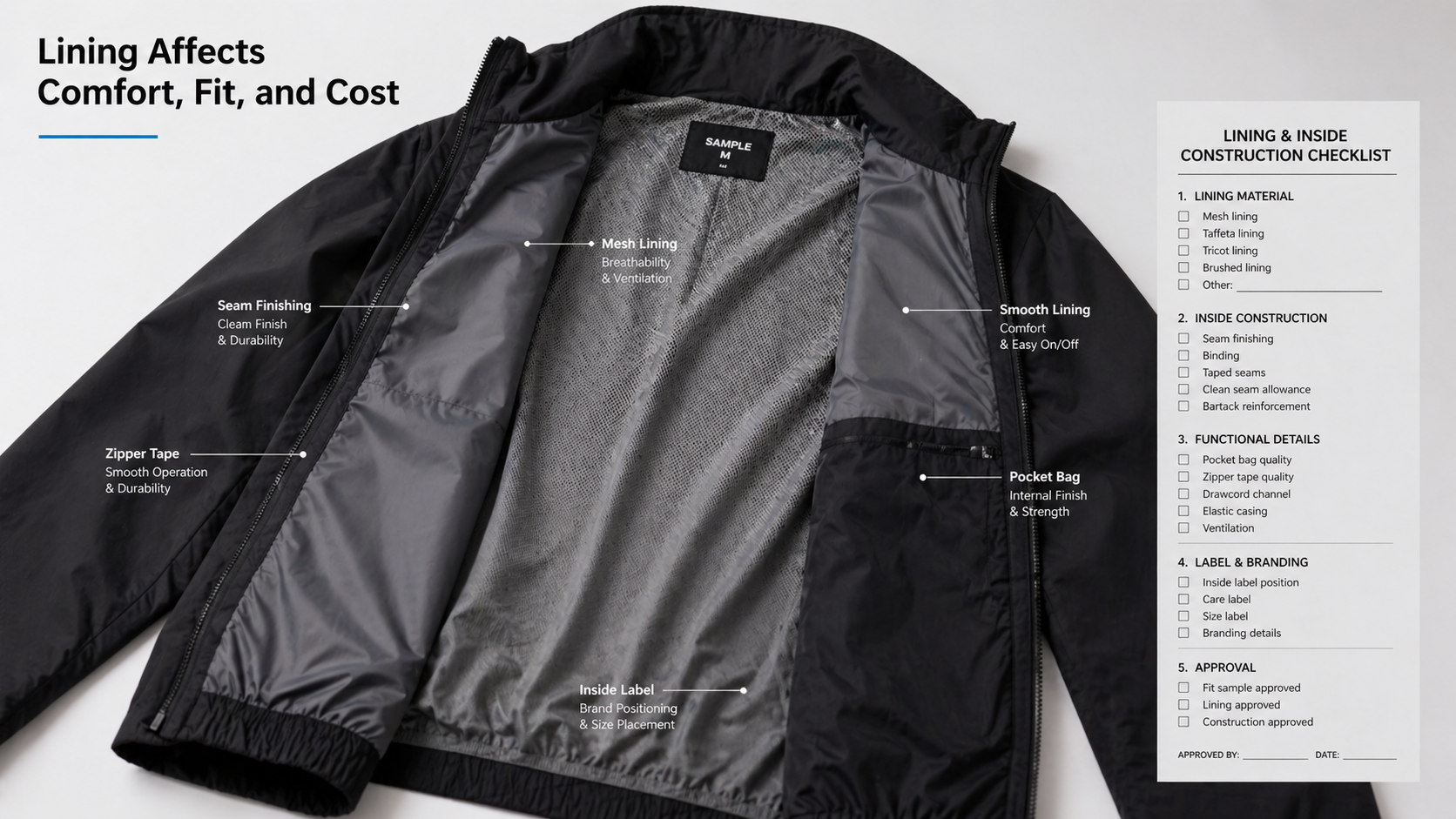
Checklist Area 2: Lining and Inside Construction
Lining changes comfort, structure, cost, fit, and production process. For nylon tracksuits, lining should be confirmed early because it affects pattern development and sample approval.
Lining Options to Check
Common lining directions include:
1.Mesh lining
2.Smooth woven lining
3.Partial lining
4.Unlined construction
5.Contrast lining
6.Color-matched lining
Mesh lining can improve comfort in many sportswear-inspired designs. Smooth woven lining can make the garment easier to wear over other layers. Partial lining may control weight and cost, but it needs clear construction planning. Unlined construction may look simple, but inside seam finishing becomes more visible.
Inside Construction Points
Check:
1.Lining coverage
2.Lining color
3.Inside seam finishing
4.Zipper tape finishing
5.Pocket bag fabric
6.Label placement
7.Inside comfort
8.Whether lining changes measurements or drape
Checklist Area 3: Fit, Size Chart, and Set Proportion
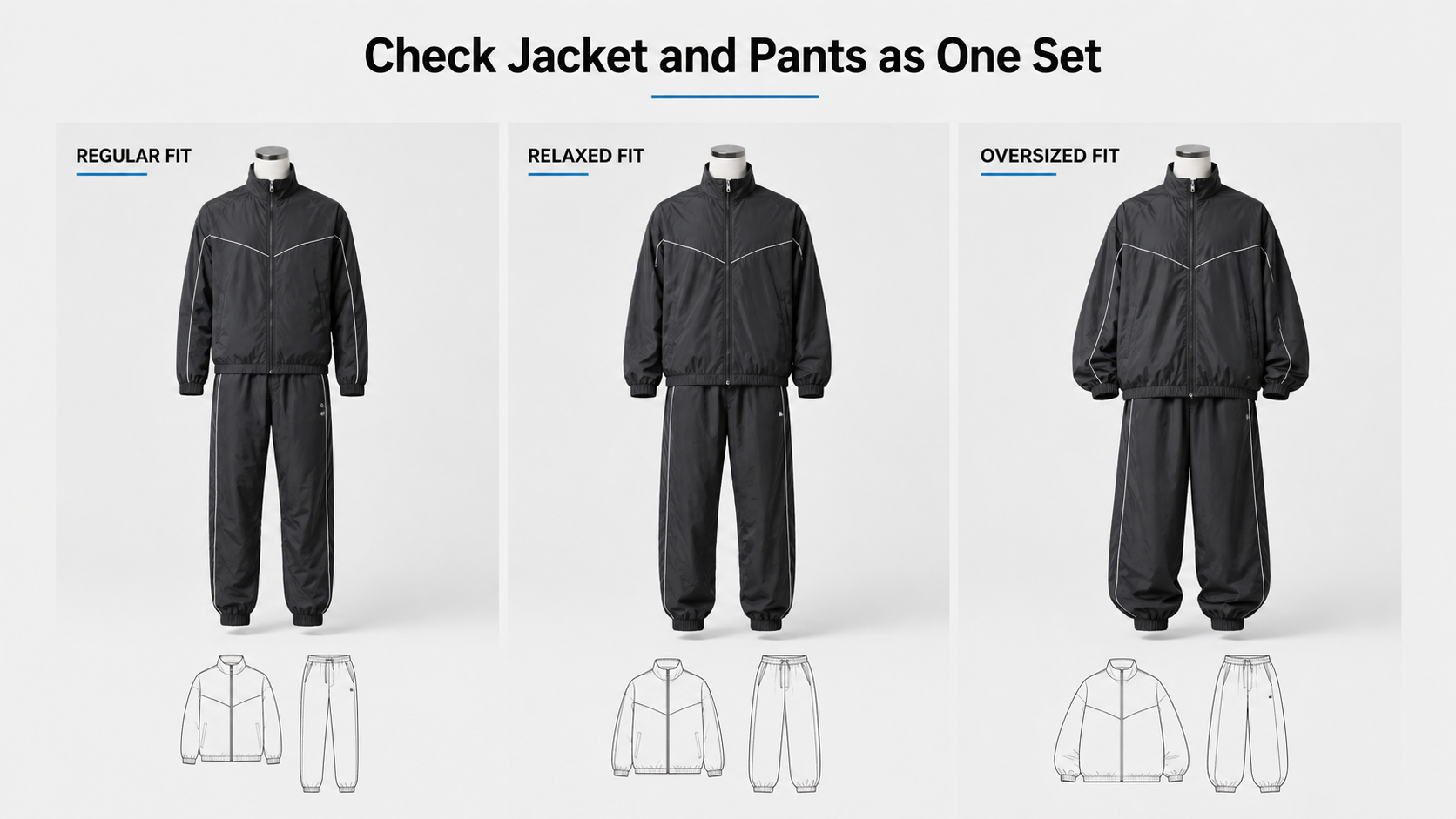
A tracksuit must be reviewed as a full set, not as two separate garments. The jacket and pants should match the intended fit direction and look balanced together.
Jacket Fit Checklist
Check:
1.Shoulder width
2.Chest ease
3.Body length
4.Sleeve length
5.Sleeve volume
6.Armhole comfort
7.Collar height
8.Hem shape
9.Cuff tension
10.Zipper length
11.Pocket position
12.Overall silhouett
Nylon does not drape like cotton fleece. Some nylon fabrics are crisp or structured, so small pattern changes can affect the final silhouette.
Pants Fit Checklist
Check:
1.Waist measurement
2.Waistband recovery
3.Rise
4.Hip width
5.Thigh width
6.Knee shape
7.Inseam length
8.Outseam length
9.Leg opening
10.Ankle cuff or hem
11.Pocket placement
12.Drawcord function
Set Proportion Checklist
Check:
1.Does the jacket volume match the pants volume?
2.Does the jacket length work with the pants rise?
3.Does the tracksuit look balanced on body?
4.Is the fit direction athletic, regular, relaxed, or oversized?
5.Are measurements within the approved tolerance?
Vanrd's Service Process can help buyers understand how sampling, fitting, revision, approval, and production planning are connected.
Checklist Area 4: Zippers, Drawcords, Elastic, and Trims
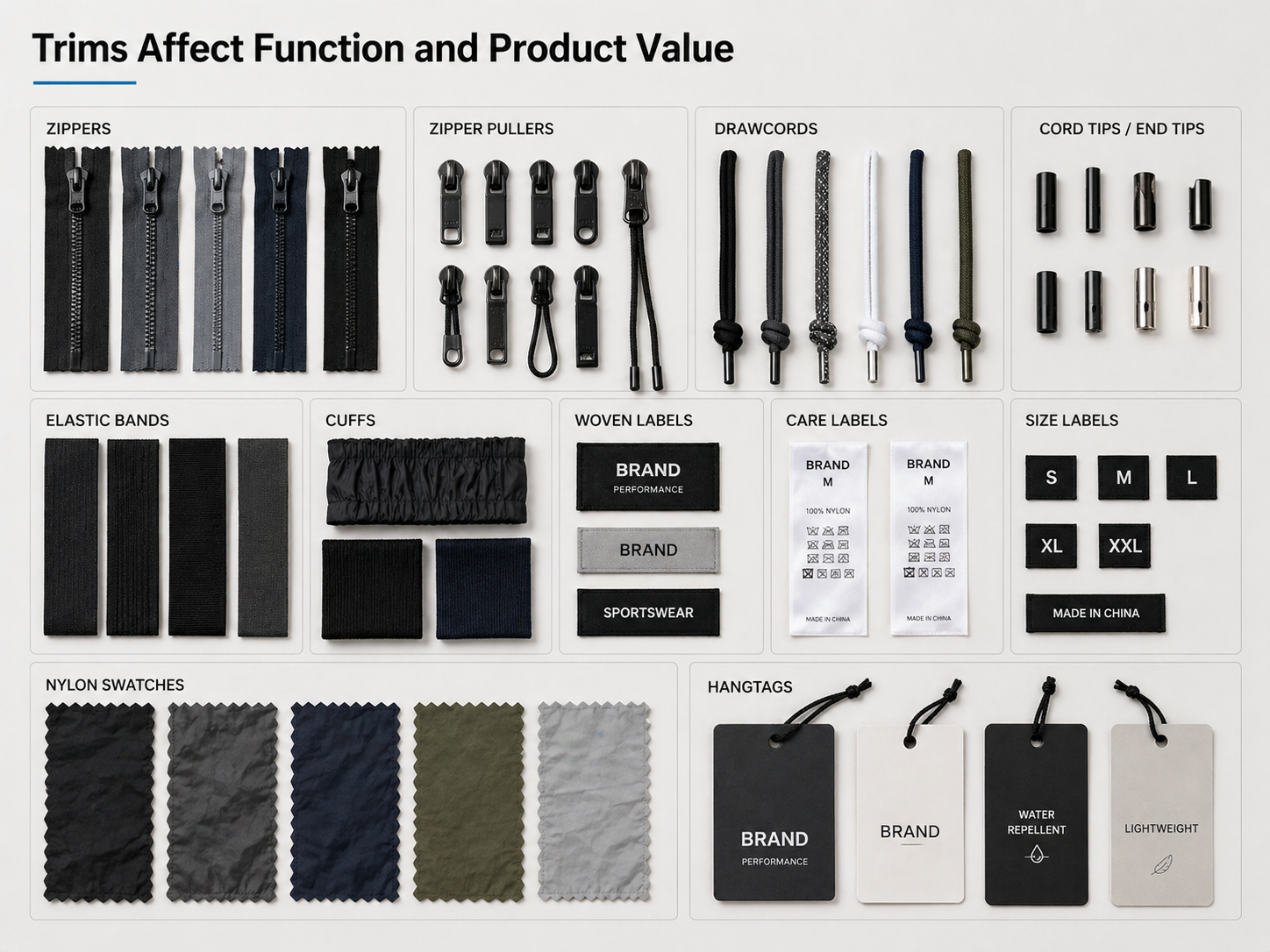
Trims are important because they affect function, appearance, durability, and perceived value. In nylon tracksuit manufacturing, trims often determine whether the product feels basic, technical, or private label ready.
Zipper Checklist
Check:
1.Front zipper size
2.Zipper smoothness
3.Zipper tape color
4.Puller style
5.Pocket zipper type
6.Concealed or exposed zipper
7.Whether the zipper causes fabric waving
8.Whether zipper ends are clean
Drawcord Checklist
Check:
1.Drawcord material
2.Drawcord thickness
3.Color matching
4.Cord tip style
5.Eyelet quality
6.Drawcord length
7.Branded or standard option
Elastic and Cuff Checklist
Check:
1.Elastic width
2.Elastic recovery
3.Waistband comfort
4.Cuff tension
5.Rib or elastic cuff option
6.Ankle opening
7.Whether elastic twists after sewing
Label and Small Trim Checklist
Check:
1.Woven label
2.Care label
3.Size label
4.Hangtag
5.Heat transfer label
6.Packaging label
7.Placement accuracy
Checklist Area 5: Pockets, Panels, and Construction Details
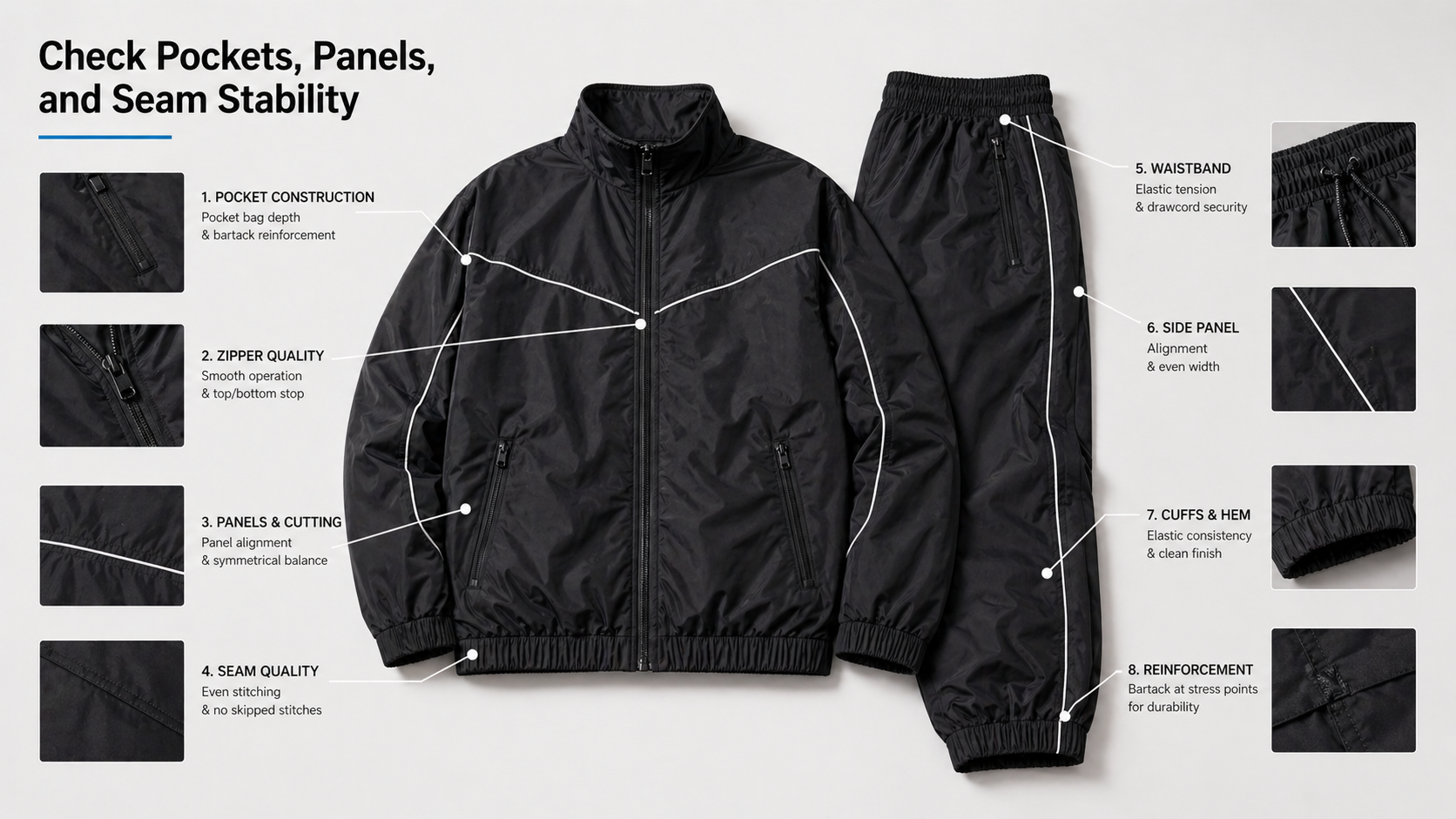
Construction details affect sewing difficulty, production stability, and final appearance. Nylon fabrics may show puckering or tension more clearly than some heavier materials, so pocket and panel design should be checked carefully.
Pocket Checklist
Check:
1.Pocket type
2.Pocket placement
3.Pocket opening size
4.Pocket bag fabric
5.Zipper pocket function
6.Seam pocket stability
7.Patch pocket shape
8.Pocket symmetry
9.Reinforcement points
Panel Design Checklist
Check:
1.Contrast panel placement
2.Curved seam lines
3.Color-block matching
4.Piping position
5.Reflective panel placement
6.Multi-fabric compatibility
7.Left-right symmetry
8.Cutting accuracy
Sewing and Seam Checklist
Check:
1.Stitch type
2.Stitch tension
3.Seam smoothness
4.Seam allowance
5.Inside finishing
6.Puckering risk
7.Reinforcement at stress points
8.Needle marks on nylon fabric
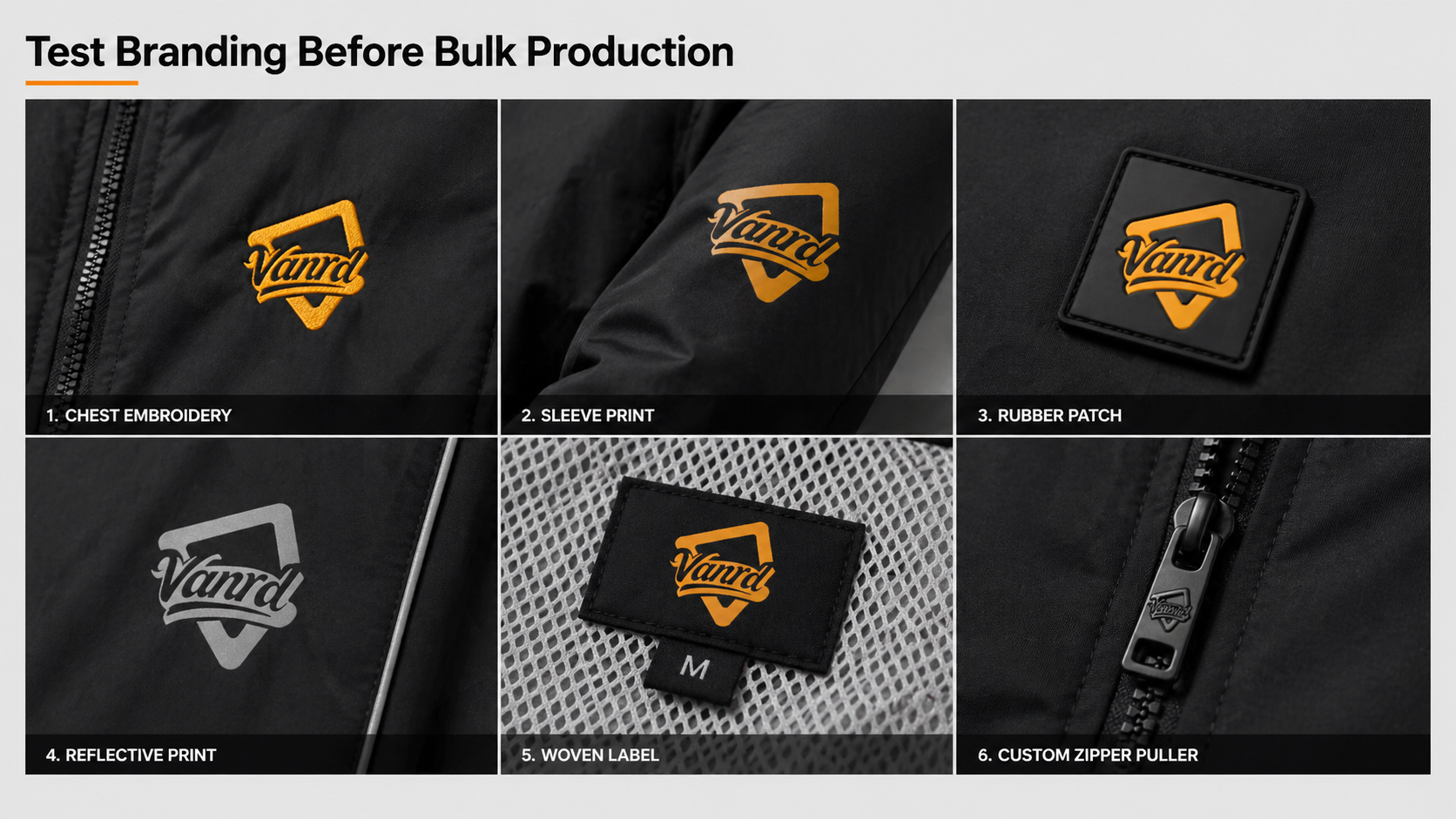
Checklist Area 6: Branding Method and Logo Approval
Branding should be tested and approved before bulk production. Nylon fabric surface, coating, and weight can affect the result of printing, embroidery, patches, and heat transfer.
Branding Methods to Check
Custom nylon tracksuits may use:
1.Screen printing
2.Heat transfer
3.Embroidery
4.Rubber patches
5.Reflective print
6.Woven labels
7.Applique
8.Custom zipper pullers
9.Branded drawcord tips
10.Inside neck labels or waistband labels
Logo Approval Checklist
Check:
1.Logo file format
2.Logo size
3.Logo placement
4.Logo color
5.Logo technique
6.Backing requirement
7.Edge finishing
8.Heat sensitivity
9.Fabric surface compatibility
10.Placement symmetry
11.Bulk consistency
For lightweight nylon, embroidery may require backing and careful tension control. For coated nylon, heat transfer and printing may need testing. For patches, weight and placement should match the garment structure.
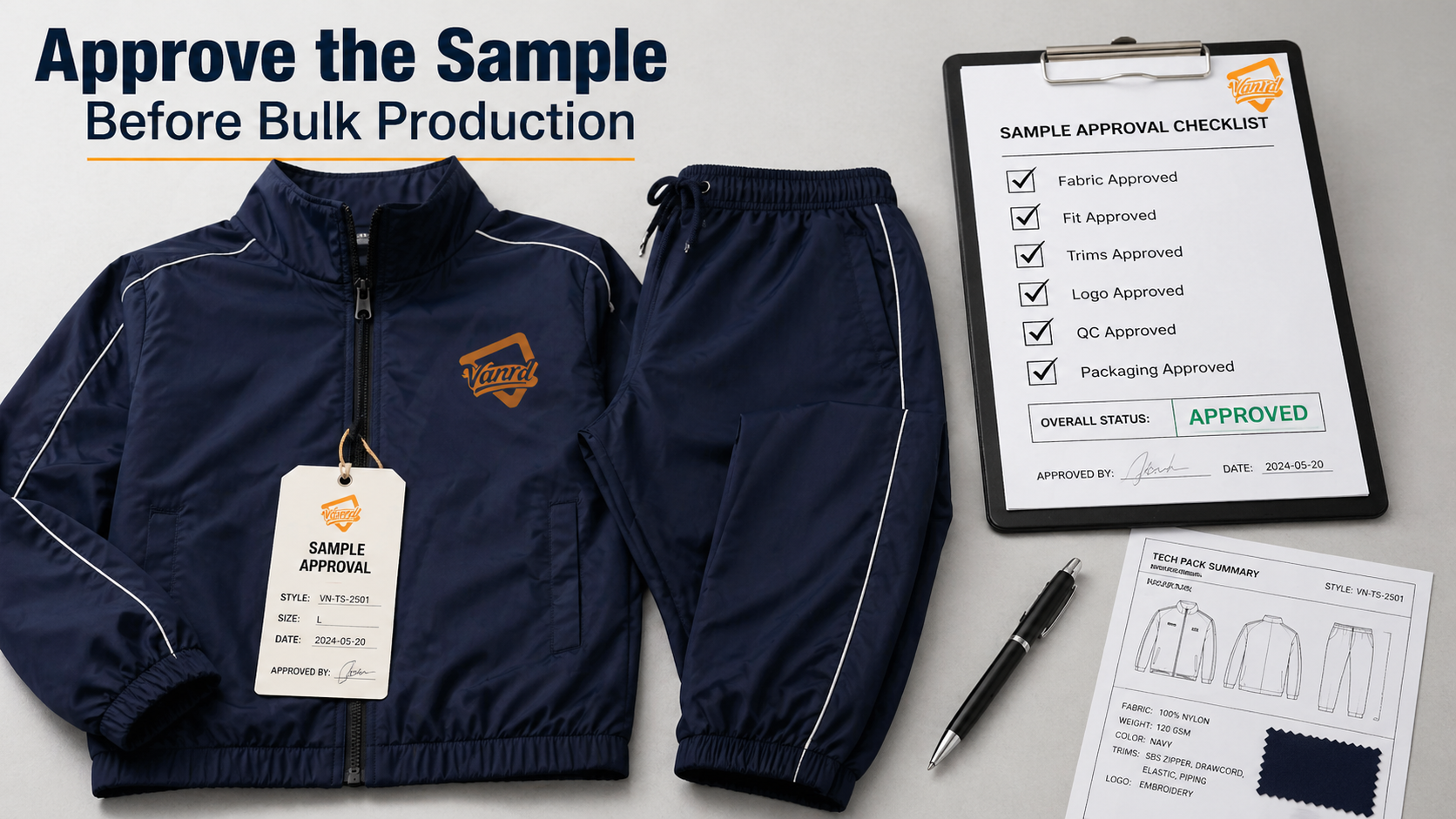
Checklist Area 7: Sample Approval Before Bulk Production
Sample approval is the bridge between development and bulk manufacturing. A sample should not be approved only because the overall look is close. It should be checked against fabric, fit, trims, branding, measurements, and QC standards.
Sample Approval Checklist
Before approving a nylon tracksuit sample, check:
1.Fabric matches approved swatch
2.Color matches approved standard
3.Lining matches approved construction
4.Jacket measurements are correct
5.Pants measurements are correct
6.Set proportion is balanced
7.Zippers function smoothly
8.Pockets are symmetrical
9.Waistband has good recovery
10.Cuffs match the intended tension
11.Logos are placed correctly
12.Labels are accurate
13.Seams are smooth
14.No major puckering
15.No obvious fabric defects
16.Packaging direction is confirmed
17.Revision comments are closed
Approval Comment Checklist
Revision comments should be specific. Instead of saying "make the fit better," buyers should write clear instructions such as:
1.Increase chest width
2.Reduce sleeve volume
3.Raise pocket position
4.Change zipper tape color
5.Adjust waistband tension
6.Move logo 2 cm higher
7.Replace lining with mesh
8.Reduce ankle opening
Specific comments help the manufacturer revise the sample more accurately.
Checklist Area 8: QC Points During Bulk Production
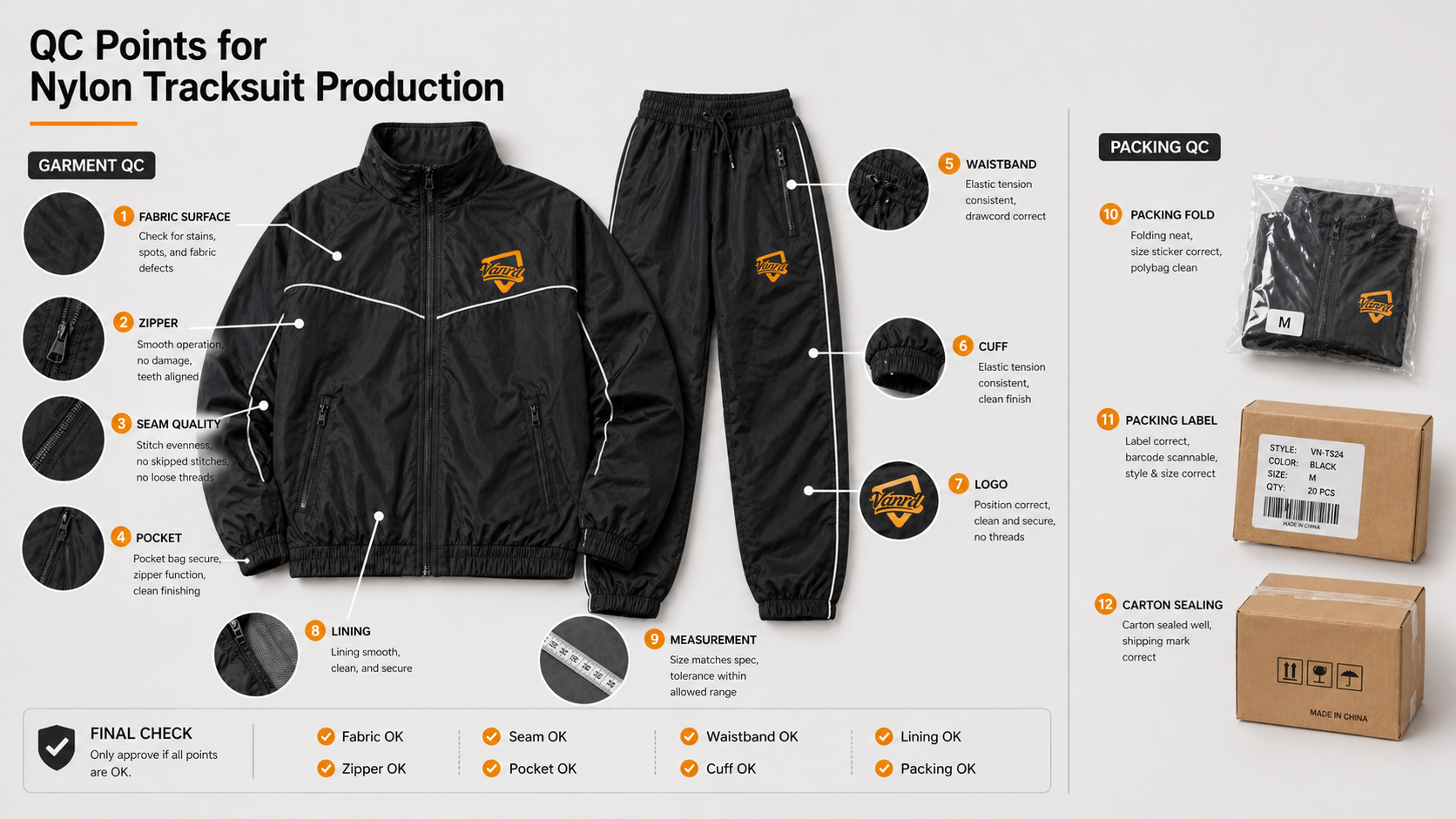
Quality control should be planned before bulk production starts. For nylon tracksuits, QC should cover fabric, measurements, sewing, trims, branding, finishing, and packaging.
Fabric QC Points
Check:
Fabric color consistency
Fabric defects
Surface finish
Coating consistency
Fabric direction
Shade difference between panels
Lining color and quality
Measurement QC Points
Check:
Jacket length
Chest width
Shoulder width
Sleeve length
Pants waist
Hip width
Rise
Inseam
Leg opening
Tolerance range
Sewing QC Points
Check:
Stitch tension
Seam smoothness
Seam strength
Puckering
Loose threads
Pocket symmetry
Zipper alignment
Waistband sewing
Cuff sewing
Branding QC Points
Check:
Logo placement
Logo size
Logo color
Print clarity
Embroidery tension
Patch attachment
Label accuracy
Label placement
Final Packing QC Points
Check:
Folding method
Polybag or packaging
Hangtag
Size sticker
Barcode if required
Carton marking
Final quantity
Shipment preparation
Buyers can review Vanrd's Q&C page to understand how inspection thinking supports custom production.
Factory Reality: A Checklist Only Works When Specs Are Clear
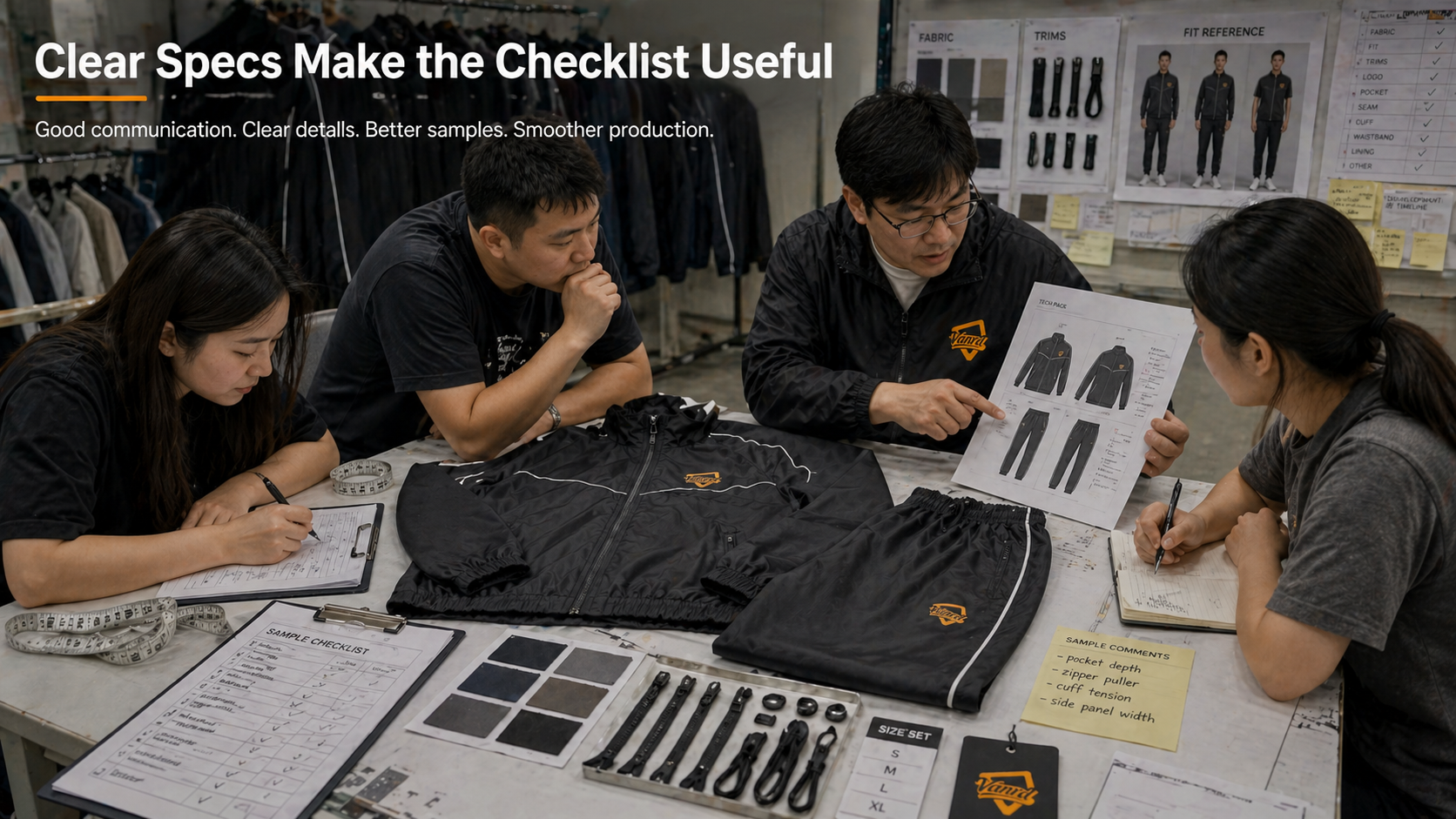
In real manufacturing, a checklist only works when the specifications are clear. If the buyer has not confirmed fabric, lining, fit, trims, logo method, size chart, and packaging, the checklist may become too general to control production risk.
A good checklist should connect directly to the approved sample and tech pack. The factory should know which fabric is approved, which measurements are acceptable, which logo placement is final, and which packaging method should be used.
For custom nylon tracksuits, small changes can affect many parts of the product. Changing fabric may affect fit and branding. Changing lining may affect measurements and comfort. Changing zipper quality may affect the jacket shape. Changing waistband construction may affect pants fit.
This is why the best checklist is not a separate document created at the end. It should be built during development, refined during sampling, and used during bulk production.
Vanrd is based in Dongguan, Humen, and supports custom apparel development for brands that need fabric selection, sampling, production planning, and QC coordination. Buyers can learn more about Vanrd's production background through Factory Strength.
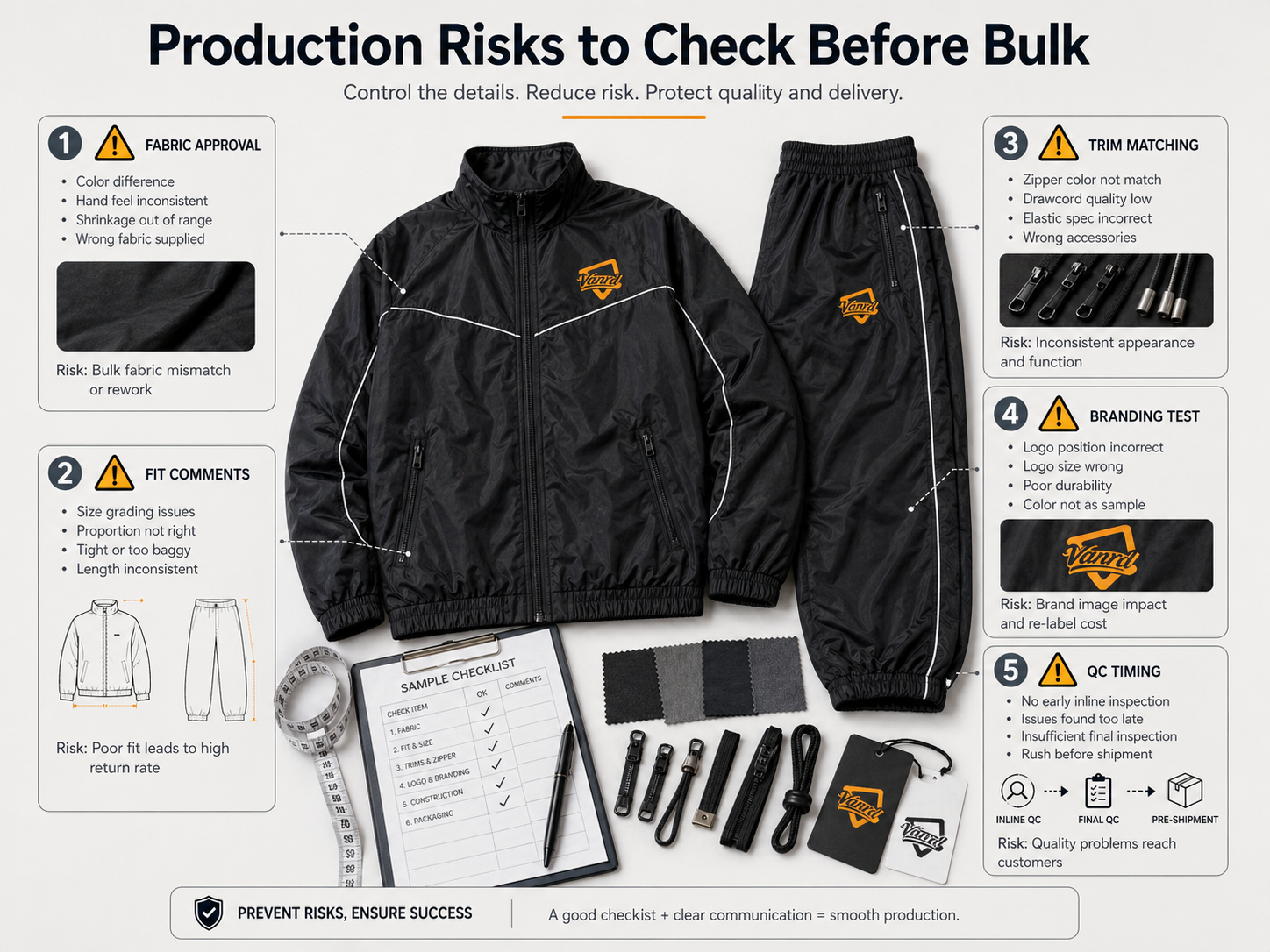
Risk Watchpoints Before Bulk Production
Risk control should happen before bulk production, not after problems appear. Clothing brands should review the following points before giving final approval.
Risk 1: Fabric Is Approved Too Early
A fabric may look correct in photos but feel wrong in real use. Buyers should confirm hand feel, weight, surface finish, color, and logo compatibility before approval.
Risk 2: Fit Comments Are Too Vague
Vague comments create repeated revisions. Fit comments should be measurable or specific whenever possible.
Risk 3: Trims Are Not Matched to the Fabric
Heavy zippers, weak elastic, poor drawcords, or unsuitable pocket construction can reduce the quality of the full tracksuit.
Risk 4: Branding Is Not Tested on the Actual Fabric
Logo methods can behave differently on nylon surfaces. Printing, embroidery, heat transfer, and patches should be confirmed before bulk production.
Risk 5: QC Standards Are Discussed Too Late
If measurement tolerance, logo placement, fabric defects, packing method, and inspection points are discussed only after production starts, risk becomes harder to control.
Common Mistakes in Nylon Tracksuit Manufacturing
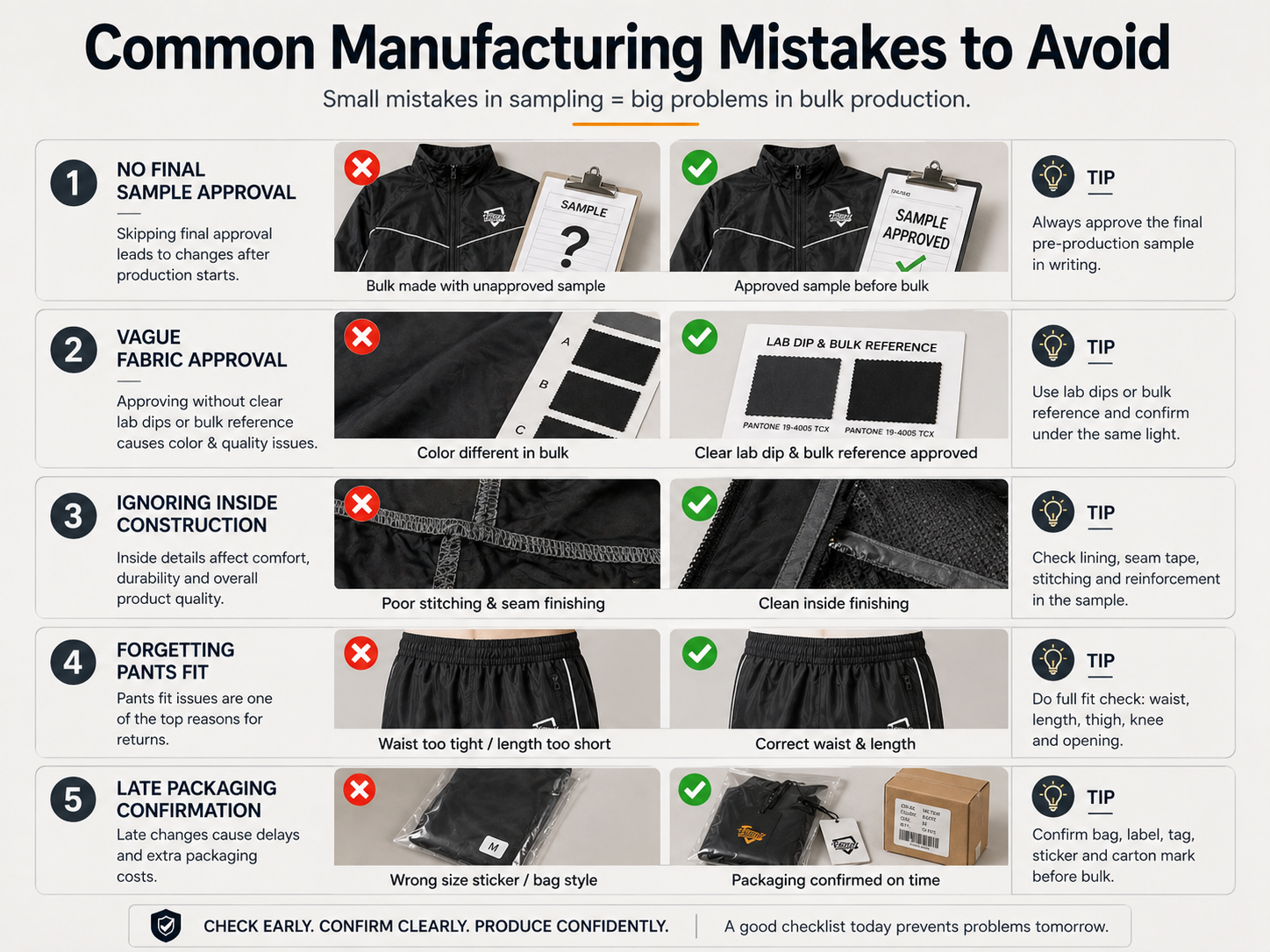
Many production problems come from unclear decisions before bulk manufacturing. These mistakes are common but avoidable.
Mistake 1: Starting Production Without Final Sample Approval
Bulk production should not begin until the sample, measurements, fabric, trims, logo, labels, and packaging are confirmed.
Mistake 2: Treating Nylon Fabric as One Standard Material
Nylon fabrics vary in weight, hand feel, coating, stretch, and finish. Buyers should approve the actual fabric, not only the material name.
Mistake 3: Ignoring Inside Construction
Lining, seam finishing, pocket bags, and inside labels affect comfort and perceived quality. These details should be included in the checklist.
Mistake 4: Checking the Jacket but Not the Pants
A tracksuit is a set. The pants must be checked with the jacket for proportion, fit balance, waistband, pockets, and leg opening.
Mistake 5: Leaving Packaging Until the End
Packaging should be confirmed before shipment preparation. Labels, hangtags, polybags, size stickers, carton marks, and folding method can all affect final delivery.
Practical Nylon Tracksuit Manufacturing Checklist
Use this checklist before moving from sampling to bulk production.
Product Information
Product name
Style number
Jacket and pants set confirmation
Target use case
Buyer approval contact
Final approved sample version
Fabric and Lining
Approved shell fabric
Approved fabric color
Approved lining type
Fabric weight direction
Surface finish
Stretch requirement
Fabric defects standard
Bulk fabric availability
Fit and Measurements
Approved size chart
Jacket measurement points
Pants measurement points
Tolerance standard
Fit comments closed
Grading rule confirmed if needed
Trims and Components
Zipper type
Drawcord type
Cord tips
Elastic waistband
Cuffs
Pocket construction
Labels
Hangtags
Packaging components
Branding
Logo artwork
Logo size
Logo placement
Logo color
Logo technique
Patch or print approval
Label placement
Branding test result if needed
QC and Packing
Fabric QC standard
Measurement QC standard
Sewing QC standard
Branding QC standard
Packing method
Carton marking
Final inspection requirement
Shipment preparation
Next Steps for Clothing Brands
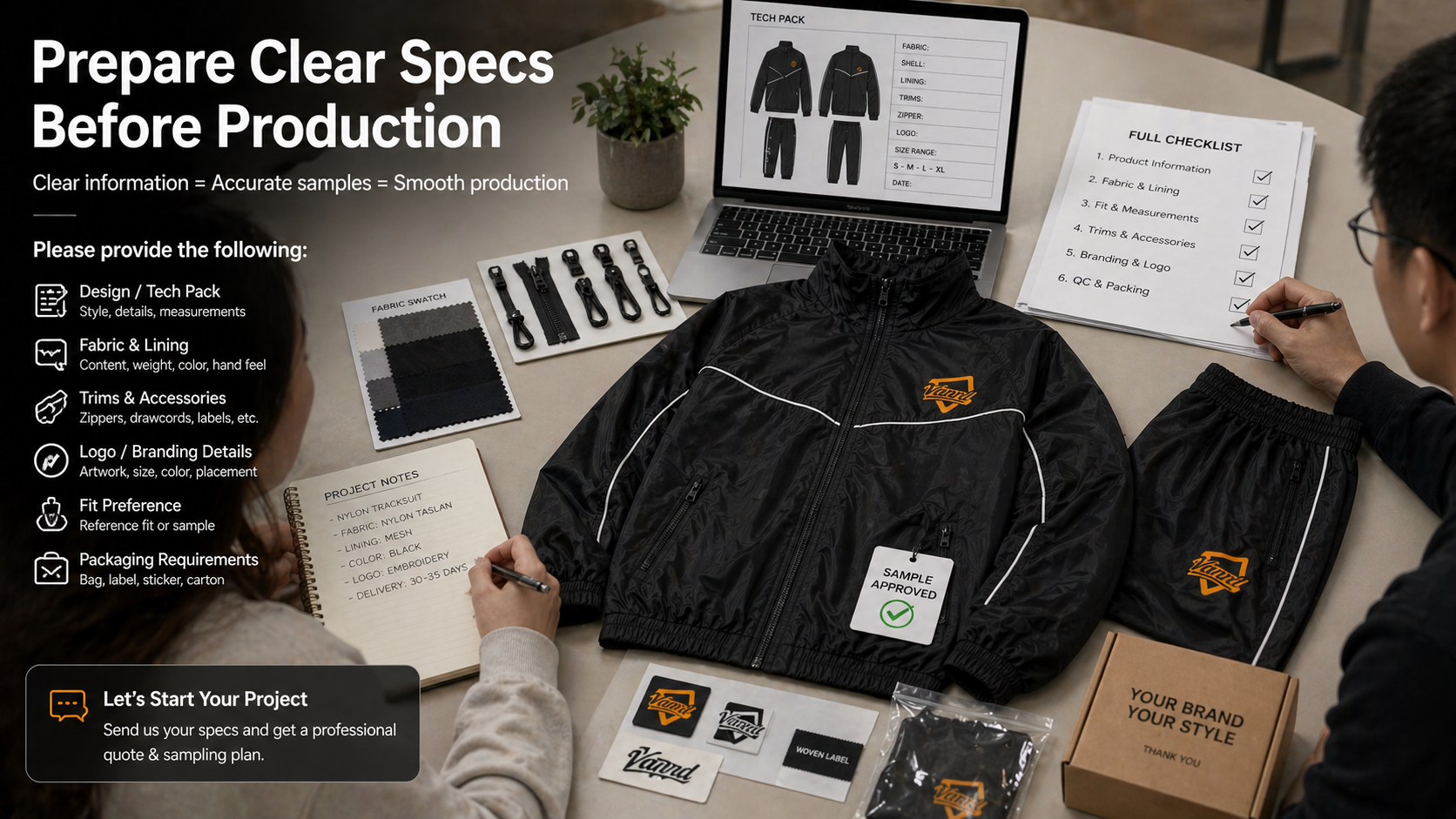
Before starting nylon tracksuit manufacturing, organize your checklist around the approved sample, fabric, fit, trims, branding, QC points, and packaging requirements. This helps the manufacturer understand what must be controlled during production.
A practical next step is to send your tech pack, reference images, approved sample comments, fabric direction, size chart, logo artwork, trim details, label requirements, packaging details, target order quantity, and QC expectations to the manufacturer.
Private label brands planning custom nylon tracksuit production can contact Vanrd through the Contact Us page to discuss sampling requirements, manufacturing details, production planning, and quality control.
FAQ
What is a nylon tracksuit manufacturing checklist?
A nylon tracksuit manufacturing checklist is a production control tool that helps buyers confirm fabric, lining, fit, trims, branding, measurements, QC standards, and packaging before bulk production.
What should be checked before approving a nylon tracksuit sample?
Before approval, check fabric hand feel, color, lining, jacket fit, pants fit, zipper function, pocket symmetry, waistband recovery, logo placement, seam smoothness, labels, packaging, and measurement tolerance.
Why does nylon fabric need extra checking before production?
Nylon fabrics can vary in weight, texture, coating, stretch, shine level, and sewing behavior. These factors affect fit, comfort, branding, seam quality, and bulk production consistency.
How can brands reduce quality issues in custom nylon tracksuits?
Brands can reduce quality issues by approving real fabric swatches, confirming size specs, testing logo methods, checking trims early, using clear revision comments, and setting QC standards before bulk production.
What files should be sent to a manufacturer before production?
Buyers should send a tech pack, size chart, reference images, approved sample comments, fabric direction, color standard, logo artwork, trim details, label placement, packaging requirements, order quantity, and QC checklist.
Does the checklist need to include packaging details?
Yes. Packaging details should be included because hangtags, polybags, size stickers, carton marks, folding method, and label placement can affect final delivery and buyer acceptance.
Should the jacket and pants be checked separately or together?
Both. The jacket and pants should be checked separately for measurements and construction, then reviewed together as a full set for proportion, fit balance, color consistency, and overall product direction.
Final CTA
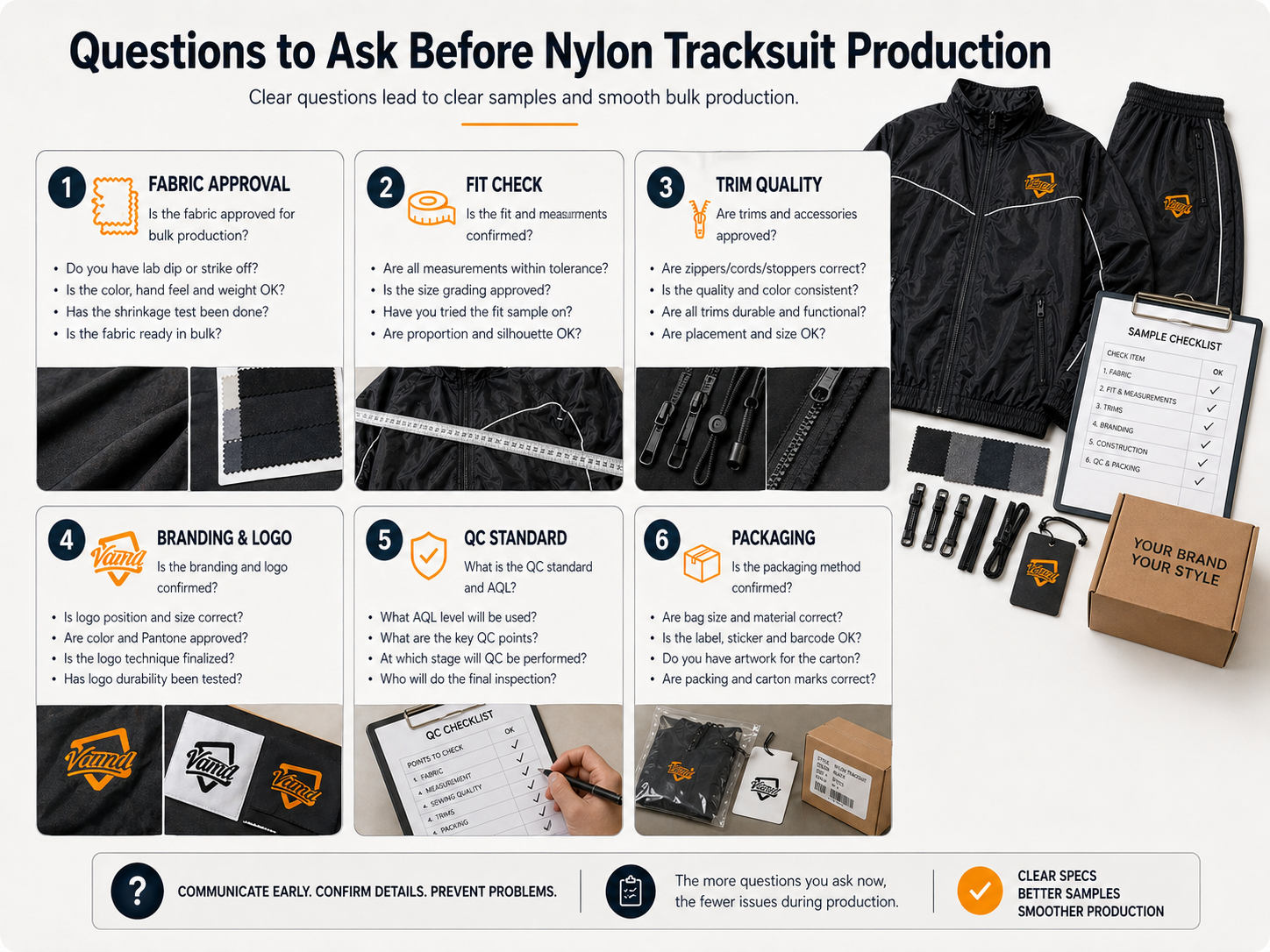
Need a clearer checklist before starting custom nylon tracksuit production?
Send Vanrd your tech pack, reference images, approved sample comments, fabric direction, size chart, logo artwork, trim details, label requirements, packaging plan, target quantity, and QC expectations. Our team can review your project details and help you prepare a clearer path from sample approval to bulk production.
Contact Vanrd to start your custom nylon tracksuit manufacturing discussion: Contact Us.