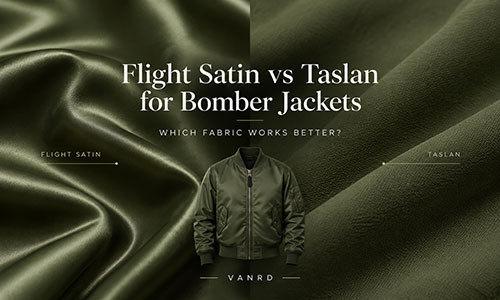
Flight Satin vs Taslan for Bomber Jackets: Which Fabric Works Better?
- Share
- publisher
- Vanrd
- Issue Time
- Oct 9,2026
Summary
Flight satin and Taslan create noticeably different bomber jacket looks. Compare their sheen, texture, fabric construction, water-repellent finishes, branding compatibility and sourcing considerations. This guide helps streetwear and private label brands choose the right shell fabric for classic MA-1, modern utility and custom bomber jacket collections.
Bomber Jacket Fabric Comparison | A Guide for Apparel Brands
Two bomber jackets can have the same pattern, zipper, rib collar and sleeve pocket, yet look like they belong to entirely different collections. Sometimes the shell fabric is the reason. One reflects light and gives you that familiar aviation-inspired shine. The other looks quieter, feels more textured and sits comfortably alongside modern utility pieces.
If you're developing a custom bomber jacket, the choice between flight satin vs Taslan is not simply about which fabric is “better.” It is about what the finished jacket needs to communicate, how it should feel in daily wear and whether your logo and finishing methods work on the selected material. Let's compare the options from a brand-development perspective.
Quick answer: For a heritage MA-1 bomber with a smooth, light-catching shell, start with nylon flight satin. For a matte, textured bomber that belongs in a utility or modern streetwear line, start with Taslan. The right choice becomes clearer once you compare finished swatches and confirm shell weight, coating and artwork requirements.
1. What Are Flight Satin and Taslan?
Flight satin and Taslan are widely used fabric terms, but they describe different aspects of textile construction. Flight satin describes a smooth flight-jacket fabric associated with a satin-style weave; Taslan points to an air-textured yarn approach. That difference helps explain their appearance before you compare exact mill specifications. Taslan may also appear as 'Taslon' in commercial fabric listings.
Flight Satin: A Smooth Flight-Jacket Shell
In bomber jacket sourcing, flight satin commonly refers to a smooth, tightly constructed synthetic shell, usually associated with nylon flight jackets. Its surface tends to have a continuous reflection that makes folds and curved sleeves catch the light. It is one reason a traditional MA-1 can look substantial even when the visible design is fairly simple.
“Satin” refers to a weave structure, not silk fiber. Longer yarn floats on the fabric face contribute to a smoother appearance and stronger light reflection. Nylon and polyester can both be used in satin constructions. When a supplier says “flight satin,” ask for the actual composition and construction instead of assuming every flight satin is identical. The Pratt Institute textile reference describes why satin weave tends to produce a smoother, more reflective face.
For a brand, the attraction is immediate: a sage-green flight-satin bomber evokes heritage military outerwear, while black or burgundy can push the same shape toward contemporary fashion. A reflective shell also makes surface creases and sewing irregularities more visible, so check the sample in the lighting you will use for product photography.
Taslan: A Textured Yarn Direction, Not a Single Performance Grade
Taslan is associated with air-textured filament yarn. Rather than presenting a uniformly smooth filament surface, the yarn gains bulk and a more textile-like character through air-jet texturing. In finished outerwear fabrics, that often translates into a softer-looking, less shiny and more cotton-like face. Commercial Taslan fabrics may use nylon, polyester or blends, with different woven structures and finishes.
A Taslan fabric can feel crisp, soft or comparatively firm depending on the weave and finishing. A published review of air-jet textured yarn technology describes the yarn-processing background. For your jacket, the useful next step is to compare the finished cloth—not just the yarn description.
Taslan works particularly well when the goal is a low-sheen streetwear shell, a utility-inspired piece or an everyday jacket that does not look overly sporty. Some versions can resemble finely textured cotton from a distance, while keeping the lightweight possibilities of synthetic filament fabrics.
| What to compare | Flight satin | Taslan |
|---|---|---|
| Visual character | Usually smooth with a stronger, more continuous sheen | Often matte to low-sheen with a textile-like texture |
| Streetwear direction | Classic MA-1, retro flight and statement outerwear | Modern utility, relaxed casual and workwear-inspired bombers |
| Handfeel and drape | Often sleek and fluid; confirm actual finished weight | Often drier or more textured; stiffness varies by finish |
| Fabric weight (GSM) | Ask for the mill's measured finished GSM | Ask for the mill's measured finished GSM |
| Construction and width | Confirm fiber content, weave, density and usable width | Confirm fiber content, air-textured yarn, weave and usable width |
| Water-repellent finish | Request actual finish and applicable test result | Request actual finish and applicable test result |
| Decoration planning | Watch for stitch puckering, shine marks and adhesion | Watch for texture affecting fine graphics and adhesion |
| Purchase decision | Approve sheen, drape and bulk color on the actual shell | Approve texture, handle and bulk color on the actual shell |
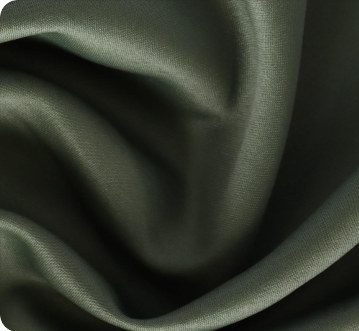
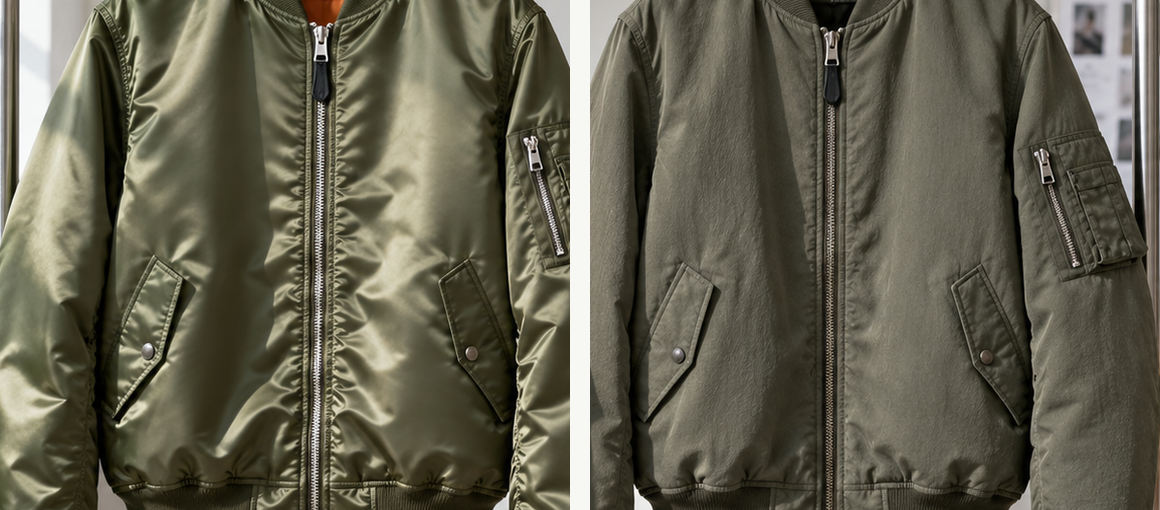
Notice the bright highlights along the folds. This is the visual direction often associated with heritage flight jackets.
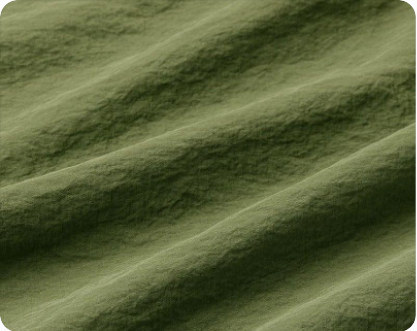
The softer-looking reflection and more broken texture create a quieter, utility-inspired impression.
2. Gloss, Texture and Jacket Appearance
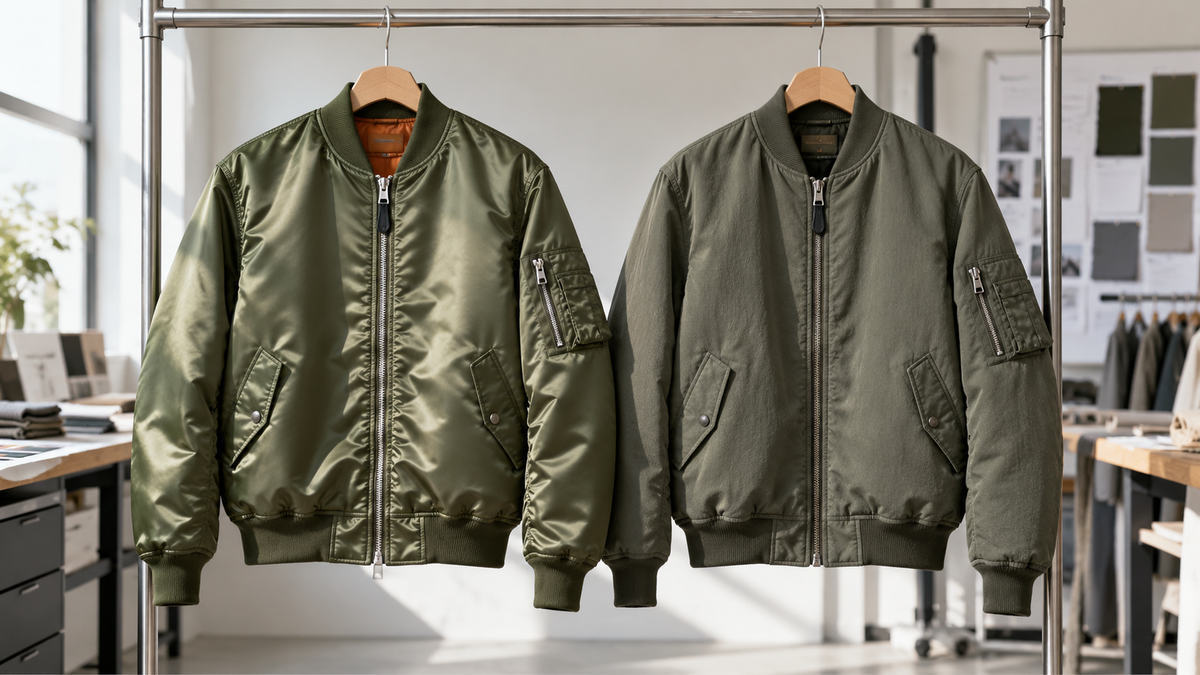
Color can be changed in a tech pack. A zipper pull can be swapped. But shell fabric changes the whole visual language of the jacket. Imagine the same cropped bomber in black: one has a reflective, almost liquid surface, while the other absorbs more light and looks closer to contemporary workwear. The garment's outline may be unchanged, yet the impression is completely different.
How Light Changes the Perceived Quality
Flight satin tends to respond strongly to direct light. The rounded sleeve cap, shoulder folds and front panels become part of the design. This can be a strength for a clean retro bomber, especially if the brand wants a familiar flight-jacket identity. It also means the material needs a careful photo review: bright flash photography can exaggerate its sheen, while a soft studio setup may make it look much more restrained.
Taslan usually provides a more even visual surface. Texture interrupts some of the high-gloss effect and can make a jacket appear more understated. This suits brands working with muted earth colors, outdoor-inspired styling and relaxed everyday uniforms. It may also help bold contrast panels or trims stand out because the base fabric is visually quieter.
Neither look is automatically more premium. A high-quality matte shell can look luxurious, and a beautiful satin can look inexpensive if it is too thin for the pattern or poorly constructed. For an established brand, the better question is whether the shell fits the rest of the collection. A shiny nylon bomber beside washed denim and heavy cotton tees creates a different story from a matte Taslan bomber beside cargo pants and overshirts.
Feel, Drape and Fit Are Connected
Shine gets attention first, but handfeel matters once a customer picks up the garment. A smooth satin may slide more easily over a sweatshirt and create clean, rounded folds. A textured Taslan may feel less slippery and more casual. However, these are tendencies, not universal performance rules. Fabric weight, yarn size, finishing chemicals, coating and lining all affect drape.
If your design uses a generous sleeve, cropped body and firm rib hem, check how excess fabric settles above the hem. On a soft shell, the body may fall into relaxed folds. On a stiffer construction, it can stand away from the waist and create a more architectural shape. Even with the same measurement chart, the visual result changes.
An existing VANRD MA-1 nylon bomber reference shows how a nylon twill shell, sleeve pocket and rib trims work together; its published shell specification is nylon twill, not a confirmed flight-satin test fabric. For your own collection, compare two actual garment panels—or ideally two sample jackets—under the same conditions. Ask your bomber jacket manufacturer to use the same fit block, lining concept and rib dimensions. Changing all of them at once makes it much harder to tell which difference comes from the shell.
Sample-photo tip: Photograph both candidate fabrics on the same jacket pattern and under identical light. Fabric close-ups show texture; full-length sample photos show how the cloth changes sleeve volume, hem shape and the overall silhouette.
3. Weather Use and Surface Finishes
A bomber can look weather-ready without being designed as a rain jacket. This is where vague descriptions become risky. A supplier might call a nylon flight satin “water-resistant,” while another calls Taslan “waterproof.” Neither statement is complete until you know which finish was applied and what test results support the claim.
Water-Repellent Is Not the Same as Waterproof
A durable water-repellent finish, often called DWR, helps water bead on the surface rather than wetting the fabric immediately. It can be used on appropriate satin or Taslan shells. However, surface beading does not tell you how much water pressure the material can resist. For meaningful rain protection, buyers may need to consider coatings, membranes, seam construction and garment design as well.
For example, a Taslan shell with a polyurethane coating may resist water penetration differently from an uncoated Taslan. A flight satin with a suitable water-repellent treatment can shed light moisture without becoming a waterproof jacket. Calling either fabric waterproof based only on its name would be misleading.
Use AATCC TM22 to evaluate surface wetting and AATCC TM127 for hydrostatic-pressure resistance. Ask which method was used, whether it applies to the proposed finish, and whether the target product claim includes garment-level construction.
Coatings Change More Than Water Resistance
Suppose your concept is a quiet, matte spring bomber. Adding a heavy coating to achieve a higher water-resistance target could make the fabric stiffer, noisier or less comfortable than the original swatch. It might also affect sewing, heat application, air permeability and how the jacket folds at the elbows. A different finishing route may keep the desired handfeel but offer a lower level of weather protection.
Likewise, calendering can alter smoothness and sheen, while softeners may change the apparent texture. Colors may look different after finishing, even if the fiber and dye formula are unchanged. Treat the final finished shell—not an unfinished color swatch—as the true approval standard.
For a casual streetwear collection, the right specification might simply be an attractive, durable shell with tested water repellency. For a technical rain-oriented line, the development brief will be different. If you need that second direction, our custom windbreaker manufacturing guide explains how shell choice connects with lining and lightweight jacket construction.
What About Wind, Abrasion and Long-Term Wear?
Both flight satin and Taslan can be made into practical outerwear shells. But it is not reliable to say that one always has better abrasion resistance or wind protection. A tightly woven high-density satin may outperform a loosely constructed textured fabric in one test, while a well-engineered Taslan may do better in another. Yarn, fiber, density, finishing and the test method matter more than the marketing label.
Before choosing a shell for repeated retail orders, ask for relevant abrasion or tear results, colorfastness, dimensional stability and any required weather tests. For a fashion bomber, the most important issue may be whether the surface scuffs and remains attractive after daily use. For a utility-inspired jacket, resistance to rough contact at cuffs, pocket edges and backpack straps could matter more.
Practical buying tip: Request the test report for the selected finished shell, not for a vaguely similar fabric name. Record the corresponding construction, finish and lot details alongside your approved swatch.
4. Branding and Trim Compatibility
Fabric selection becomes more interesting when you add a logo. Many bomber jackets use a small chest mark, a sleeve patch or a large back graphic. The right decoration technique can make the design feel intentional. The wrong one may leave needle marks, wrinkled panels or poor adhesion—and it is much easier to spot those problems on a prominent jacket than on a basic T-shirt.
Embroidery and Patches
Flight satin is a strong visual partner for embroidered badges, appliqué and heritage-style patches. The contrast between a luminous background and a textured logo can be striking. Yet a smooth, relatively light shell may pucker around dense stitches or show needle holes more clearly. Backing material, stitch density, hoop pressure and placement all deserve testing.
Taslan also works with embroidery and patches, but its surface texture creates a different effect. A fine outlined mark can lose some crispness if the weave is coarse. On the other hand, a slightly matte face may feel especially natural with woven labels, rubber badges or utilitarian branding. The outcome depends on the exact fabric and the artwork, not a blanket rule that Taslan is more embroidery-friendly.
For either material, avoid approving a logo solely from a digital mockup. Request a test on the actual bulk shell, ideally with the same backing and lining arrangement that the jacket will use. Check both the front and the reverse so the finished garment looks clean.
Screen Printing and Heat Transfers
Could you print a large graphic directly onto nylon flight satin? Sometimes, yes, with a suitable system and controlled production settings. But a slick surface, water-repellent finish or coating can make ink adhesion more demanding. The same issue can arise on Taslan, despite its textured look. Surface chemistry matters as much as how rough or smooth a material feels.
Heat transfers introduce another variable. Synthetic fibers and coatings can react to temperature and pressure, leading to shine marks, distortion or changes in handfeel. Ask for a test with the intended print or transfer process, followed by appropriate washing or rubbing evaluation. When a graphic is the central selling point, choose the shell and decoration together instead of approving them separately.
If you're still considering embroidered patches, printed logos or custom labels, the options in VANRD's Fabrics & Techniques resource can help you narrow the direction before ordering final strike-offs.
Matching Ribs, Zippers and Lining
A bomber jacket is more than its shell. Collar, cuffs and waistband create the recognizable blouson shape, while the zipper and sleeve pocket determine how technical or minimal the piece feels. A polished satin can look especially sharp with clean metal hardware and tightly knitted ribbing. A matte Taslan may pair naturally with tonal zippers, quiet black hardware and a more utilitarian trim palette.
That is a style observation, not a restriction. A brand can intentionally put contrasting hardware on matte Taslan or tone-on-tone trims on satin. What matters is checking the entire material story together: shell, rib yarn, zipper tape, snap finish, pocket bags and lining color. A navy shell may match a rib in daylight but reveal an obvious cast difference under store lighting.
Where the jacket includes padding or a quilted lining, check the shell's behavior over the insulation. A stiff coated shell might exaggerate the puffiness of the body, while a soft satin can create rounder folds. The fabric does not set warmth by itself; insulation weight, lining, openings and complete garment construction are the larger factors.
5. Which Shell Should Your Brand Choose?
Choose according to the collection you are building. A satin flight bomber and a matte utility bomber can share a pattern but tell very different brand stories.
Choose Flight Satin For...
A classic MA-1 direction, vintage aviation references, saturated colors, reflective styling and contrast embroidery. It is a natural candidate when the jacket itself should be a visual statement.
Choose Taslan For...
A more muted streetwear line, workwear-inspired styling, relaxed casual outerwear and a textured shell that fits alongside cargos, washed tees and utility overshirts.
For Heritage MA-1 and Retro Flight Collections
For a heritage-style MA-1, approve the exact sheen before sampling: compare an olive shell in daylight, indoor lighting and product photography. Check how it looks beside the rib knit and zipper finish. Decide the warmth level separately through lining and insulation; shell shine does not determine insulation performance.
You might also compare your material direction with our MA-1 vs L-2B bomber jacket guide. It explores silhouette and season, while this article focuses on how the fabric changes the garment's surface and development requirements.
For Matte Streetwear and Utility-Inspired Jackets
For a workwear-influenced bomber, narrow the Taslan options by surface texture, stiffness and color availability before committing to a fit. Check the fabric next to your intended cargo pants, overshirts or washed cotton pieces, then review the full jacket silhouette—not just a close-up swatch.
Choose the texture scale deliberately. A fine Taslan can appear nearly smooth in campaign photos, while a more visible texture can become a signature feature across broad sleeves and back panels. Review close-ups alongside a full garment sample.
For Mixed Collections, Test the Same Pattern in Both
You do not have to choose a single fabric direction for an entire brand. Consider a focused two-style program: a satin flight bomber as the hero piece and a matte Taslan variation for everyday use. That can make sense when both products have clear identities rather than being near-duplicates competing for the same customer.
Before committing, compare the cost and practical complexity of each version. Different minimum fabric quantities, available colors, special finishes, lining requirements and decoration methods may affect the final budget. A less expensive shell can still lead to a more expensive jacket if it requires additional coating, handling or rework. Ask for comparable specifications, not simply two prices labeled “satin” and “Taslan.”
Fabric Specification Checklist: What to Request From Your Supplier
Ask for a completed specification card for each candidate shell. You do not need impressive numbers; you need comparable numbers and a swatch that matches them. Use this checklist before you pay for two full jacket samples.
| Specification | What the brand should request | Why it changes the decision |
|---|---|---|
| Fiber and weave | Composition, woven structure, yarn/denier information | Prevents buying a different quality under the same trade name |
| Finished GSM and width | Measured finished fabric weight and usable cut width | Influences drape, consumption and price comparisons |
| Handle and appearance | Physical swatches, sheen reference, drape and color standard | Confirms the visual brief instead of relying on online photos |
| Finish | DWR, coating/lamination and relevant finished-fabric test results | Explains changes in handfeel and realistic weather claims |
| Durability requirements | Relevant abrasion, tear, seam and colorfastness reports as applicable | Defines performance without assuming one fabric is stronger |
| Artwork compatibility | Test embroidery/print on the actual shell and intended backing | Catches puckering, transfer marks and adhesion problems |
| Commercial terms | Available colors, fabric MOQ, price basis, lead time and reorder policy | Connects fabric choice with launch budget and replenishment |
Compare the two cards side by side, then develop the stronger candidate first. If your collection depends on both a glossy hero jacket and a matte everyday version, test one controlled sample in each shell. VANRD's quality control overview explains the larger material and garment checks used during production.
Choosing Between Flight Satin and Taslan?
Share your bomber jacket reference or tech pack, target season, logo artwork and estimated order quantity. Our team can help review shell, lining and trim choices before sampling, so you can compare fabric options against your collection goals.
Discuss Your Bomber Jacket Fabric OptionsConclusion
For an MA-1-inspired bomber where sheen is part of the design, flight satin is the stronger starting point. For understated, textured outerwear that complements utility streetwear, start with Taslan. Then choose on evidence: finished fabric samples, compatible branding tests and a clear specification card. That gives your collection a deliberate look and a realistic path from sample to bulk.
Frequently Asked Questions
1. Is flight satin always made from nylon?
No. Nylon is strongly associated with the classic flight-jacket look, but satin describes the fabric structure rather than a required fiber. Ask the supplier to state the exact fiber content before confirming the material.
2. Does Taslan automatically resist rain better than flight satin?
No. Both can be supplied with or without water-repellent treatments, and a coating can change performance significantly. Compare test results from the finished fabrics rather than relying on their names.
3. Which fabric is better for a large embroidered back logo?
Either may work, provided the logo density, backing and embroidery process suit the shell. Flight satin may reveal puckering more readily; textured Taslan may affect the clarity of fine details. Always approve a strike-off on the selected material.
4. Can we use Taslan for an MA-1-inspired bomber jacket?
Yes. An MA-1-inspired pattern can be developed with Taslan if your goal is a more matte, updated interpretation. Just expect the handfeel and drape to differ from a traditional glossy flight-satin version.
5. What should a brand send to compare fabric options before sampling?
Send a jacket sketch or reference photo, intended season, target color, preferred fit, logo artwork and expected quantity. A target shell weight or physical swatch is useful, but the finished fabric and garment sample should determine the final approval.
Technical background: Pratt Institute: weave structures; 2024 review: air-jet textured yarn; AATCC TM22 and TM127. Fabric photographs are illustrative; this article does not claim laboratory results for either pictured material.