Crewneck Sweatshirt vs Hoodie: Which Should Your Streetwear Brand Launch?
- Share
- publisher
- Vanrd
- Issue Time
- Oct 21,2026
Summary
Should your streetwear brand launch a crewneck sweatshirt or a hoodie first? Compare their fit, style, target audiences, fabric choices, branding options, manufacturing costs and MOQ considerations. This guide helps clothing brands plan an initial collection, choose the right product for their customers and prepare for custom sweatshirt or hoodie production.
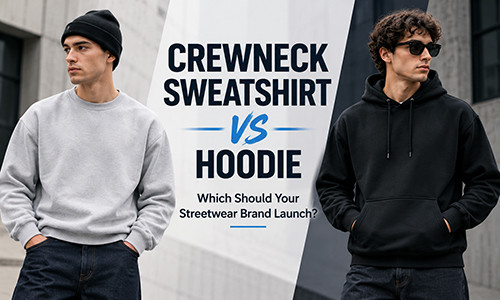
Your first streetwear drop does not need twenty styles. It needs one product that makes people understand your brand. For many labels, that choice comes down to two familiar pieces: a crewneck sweatshirt or a hoodie.
They may be made from the same fleece, carry the same logo, and sit next to each other on a product page. Yet they tell slightly different stories. A crewneck can feel understated and easy to layer. A hoodie brings its own silhouette, with a hood that becomes part of the outfit. So which one deserves a place in your launch?
The useful answer is not simply “hoodies are more popular” or “crewnecks cost less.” Your customer, design direction, fabric, decoration, pricing and launch quantity matter more than a general fashion preference. This guide compares both styles from the perspective of a clothing brand preparing an actual collection.
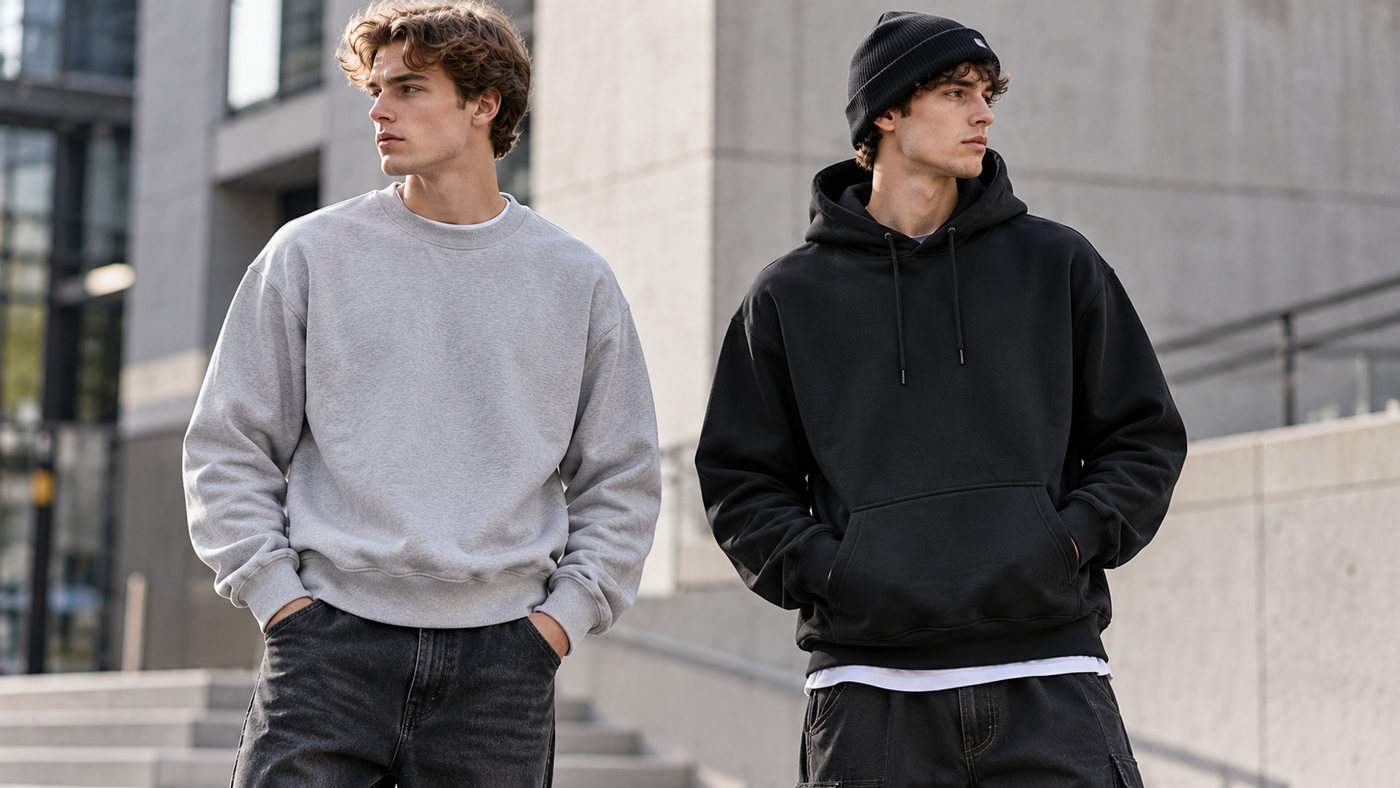
Quick answer: Launch a crewneck sweatshirt first if your brand is built around minimal graphics, versatile layering, and a simpler development brief. Launch a hoodie first if the hooded silhouette is central to your streetwear identity, your customers expect a strong standalone piece, or your launch is built around oversized fleece. If you already know both designs can sell and your budget allows two styles, develop a small coordinated capsule using matching materials and branding.
1. Crewneck vs Hoodie: Main Differences
A crewneck sweatshirt is a pullover sweatshirt with a round, hoodless neckline, usually finished with a rib collar, cuffs and hem. A hoodie is a sweatshirt with an attached hood. Many pullover hoodies include a kangaroo pocket and drawcord, although those details are optional. Both can be made in cotton fleece, cotton-poly blends or French terry, and both can be developed in regular, relaxed, cropped or oversized fits.
This distinction matters because “crewneck versus hoodie” is a comparison of garment structures, not a competition between slim and oversized clothing. A wide, dropped-shoulder crewneck may look more dramatic than a regular-fit hoodie. Likewise, a cropped hoodie can feel neater than a long, slouchy crewneck. Think of the neckline as the frame; the pattern and fabric are what complete the picture.
| What to compare | Crewneck sweatshirt | Pullover hoodie |
|---|---|---|
| Defining feature | Round neckline; no hood | Attached hood; may have a drawcord and pouch pocket |
| Visual impression | Clean, quiet, adaptable | Casual, layered, more visually substantial |
| Layering | Sits easily beneath overshirts and jackets | Hood becomes visible when layered under outerwear |
| Front branding | Usually offers a continuous front panel | Pocket and hood-related details can limit some placements |
| Construction | Body, sleeves and rib neckline | Additional hood panels and sometimes pocket/drawcord components |
| Development focus | Neck rib recovery, body proportions, fabric finish | Hood shape, neck bulk, pocket position, plus the same body controls |
| Typical first-drop role | Core basic or branding canvas | Signature fleece piece or layering hero |
How the silhouette changes the outfit
Try imagining your garment under a work jacket. With a crewneck, the collar remains almost invisible, leaving the jacket's shape to lead. Put a hoodie underneath and the hood sits around the neckline, adding another layer and shifting the proportions. Neither approach is automatically more stylish; they communicate different intentions.
The same difference appears in product photography. A plain crewneck lets attention fall on shoulder shape, fabric surface, and a front graphic. A hoodie can create a recognizable outline even with little or no decoration. If your brand sells the silhouette as much as the artwork, that extra structure may be part of the appeal.
Is a hoodie always warmer?
Not necessarily. The hood gives additional head and neck coverage, but warmth also depends on fabric weight, construction, brushing, fit and what the customer wears underneath. A dense, brushed crewneck can feel warmer through the torso than a lightweight, unbrushed hoodie. It is better to compare specific samples than assume the garment name determines temperature comfort.
For custom production, this is why fabric approval matters alongside style selection. A hoodie made from thin loopback French terry and a crewneck made from heavy brushed fleece are not equivalent products simply because both are called sweatshirts.
2. Which Fits Your Target Audience?
Here is where the decision becomes less about fashion definitions and more about who is actually buying from you. A streetwear label with subtle tonal branding is not speaking to the same customer as a graphic-led skate brand, even if both sell oversized fleece. Your first launch should feel like a natural extension of what your audience already likes.
Minimal streetwear and elevated everyday basics
For labels built around clean colors, small embroidery and wardrobe versatility, the crewneck is a convincing starting point. Its open front panel can hold a subtle chest mark, while the rib neckline keeps the overall look restrained. It pairs naturally with denim, tailored trousers, cargo pants and outerwear, which gives you several styling directions without changing the product itself.
That does not make a minimal hoodie a bad idea. A dense oversized hoodie with carefully developed hood volume can also look refined. But if you want customers to notice fabric, color and the precision of your fit rather than an obvious garment feature, a crewneck gives those choices more room to speak.
Graphic streetwear, skate culture and creator-led drops
For a label whose identity revolves around expressive graphics, music, skatewear or a recognizable oversized silhouette, a hoodie may feel more immediate. It is a complete outfit anchor: worn with baggy jeans or shorts, it has a recognizable shape even when there is no jacket on top. A strong hoodie can also carry a large back print, sleeve details or a carefully placed front graphic.
However, think about where the artwork actually goes. A kangaroo pocket can interrupt a design that looks perfect on a flat digital mockup. If the front graphic needs a large uninterrupted print area, a crewneck may present it more cleanly. Do not pick a hoodie first and then force every artwork concept to work around the pocket.
Lifestyle collections, merchandise and broader audiences
A merch line for a creator, club or event often has a more varied audience than a niche streetwear label. Some buyers want the comfort and familiar shape of a hoodie; others prefer a crewneck for work, travel or layering. Offering both may be useful when you have evidence of demand, but it is not automatically the right launch strategy if it doubles your initial stock commitment.
A practical approach is to examine your strongest audience signals before sampling. Look at the styling in customer-submitted photos, the products your followers already discuss, the climate of your main sales markets, and the price point your audience responds to. If you run a small preorder or product survey, ask customers to choose between actual mockups with the same color and artwork rather than two unrelated designs.
For brand teams exploring a broader collection, our guide to developing custom streetwear collections explains how product direction, samples and production planning fit together.
3. Fabric and Branding Options
One useful advantage of this comparison is that you do not have to invent two separate fabric stories. Crewnecks and hoodies can often be developed from the same fleece family, which makes it easier to coordinate colors, handfeel and photography. The important question is whether that fabric behaves correctly in both garment structures.
French terry or brushed fleece?
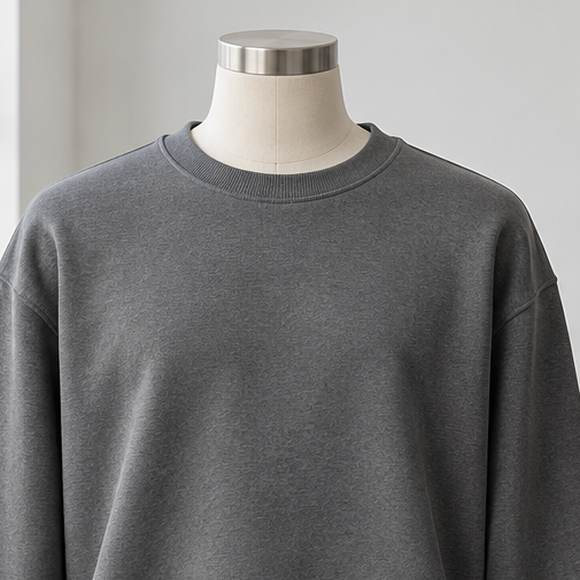
French terry has a looped or loopback interior when left unbrushed. It can create a more relaxed, less plush wearing experience and is often considered for transitional seasons or year-round basics. Brushed fleece has a raised interior finish that feels softer and is commonly selected for warmer, cozier products. Both materials can be used for either style.
Start by feeling actual fabric swatches, not just reading a composition label. Two fabrics with similar cotton content can drape differently because of yarn, knit density, finishing and shrinkage behavior. A smooth face may be better suited to a crisp print, while a more textured surface changes how ink or embroidery looks. If you want to understand the materials and rib trims VANRD can discuss for crewnecks, see our crewneck fabric and trim overview.
Choose GSM for the fit you want, not for a trend
Fabric weight is usually expressed in GSM, or grams per square meter. It is useful for comparing swatches, but it is not a universal score for quality. A heavier fleece can help a boxy silhouette hold its shape; a lighter one can make layering more comfortable. Excessive weight, however, can make the hood feel bulky or cause a cropped piece to hang awkwardly.
For an initial direction, brands often explore midweight fleece around 280–350 GSM and denser streetwear styles around 350–450 GSM or above, depending on construction and desired feel. These are broad design references, not fixed industry grades or a VANRD specification. Approve your actual swatch and sample, including the finish after laundering.
Prints, embroidery and logo placement are not interchangeable
Crewnecks offer an easy canvas for centered graphics, chest embroidery and designs that need a continuous front surface. Hoodies can offer excellent branding opportunities too, especially on the back and sleeves, but the pocket and hood may affect size, placement and artwork balance. A hooded sample may also need additional consideration around thick embroidery, seams, or print exposure after the hood lies flat.
For both styles, the method should fit the fabric and target price. Screen print suits many repeat graphic programs; embroidery works well for restrained logos or tactile accents; puff printing, appliqué and chenille can create more dimensional streetwear graphics. They do not behave identically on every fleece. Test the design on your chosen material, with the real garment construction, before approving bulk artwork.
If your brand plans to use several techniques in one drop, VANRD's crewneck customization options provide a useful starting point for discussing decoration and private-label finishing.
Develop the fit separately, even with shared fabric
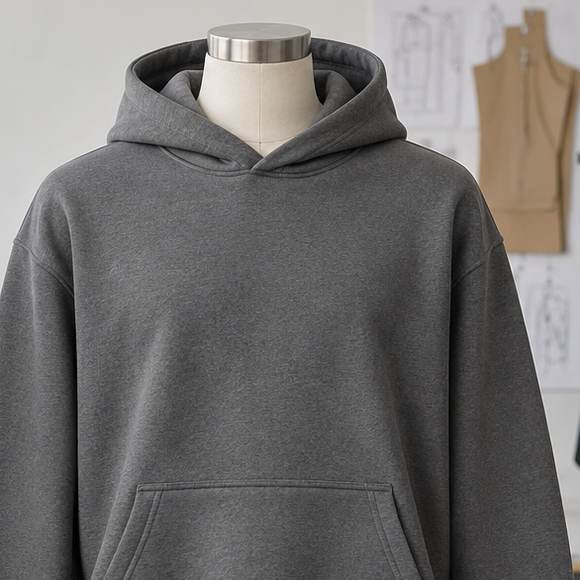
A common shortcut is to approve one crewneck pattern and imagine that adding a hood will create the perfect hoodie. In practice, neckline balance, hood weight, shoulder width and overall garment length still need attention. The reverse is true too: removing a hood does not automatically produce an excellent crewneck.
For both samples, check shoulder placement, sleeve volume, chest width, body length, cuff tension and hem recovery. For a crewneck, check that the neck opening is comfortable without stretching out of shape. For a hoodie, review hood opening, depth, how the hood sits when down, and whether the pocket is positioned naturally across different sizes.
4. Cost and Collection Planning
It is tempting to compare one factory unit price for a crewneck with another for a hoodie. But unless the fabric, weight, branding, quantity and packaging are aligned, that tells you very little. Your brand is deciding how much inventory and development risk to carry, not merely which garment uses fewer sewing minutes.
Why a crewneck can cost less to manufacture
When both garments use the same fleece, decoration, quantity and workmanship standard, a basic crewneck often requires fewer components. A typical pullover hoodie adds hood panels, and may require drawcords, eyelets and a kangaroo pocket. Those additions can increase material consumption, cutting work and sewing operations. That is why a crewneck may come in at a lower unit cost in a like-for-like quotation.
Still, it is not a rule that every crewneck is cheaper than every hoodie. A heavyweight crewneck with garment washing, large chenille artwork and custom ribbing could easily be more expensive than a simple midweight hoodie. The final quote follows the full specification. VANRD's hoodie MOQ and pricing explanation outlines the information a factory needs before comparing cost tiers.
How MOQ changes when you add a second style
For VANRD's current standard custom crewneck and hoodie programs, plan around 100 pieces per style and color, subject to the final fabric, trims and project requirements. Sizes can generally be distributed within an eligible style-color quantity, but adding another style or color may create another MOQ requirement. You should never assume that 50 crewnecks and 50 hoodies can be combined to satisfy one 100-piece style minimum.
Consider a hypothetical first drop. You choose one charcoal crewneck and one charcoal hoodie, both in matching fleece. If the relevant MOQ is 100 pieces per style-color, the starting plan is 100 crewnecks plus 100 hoodies: 200 garments, before any extra colorway is introduced. If you add a second color to each style at the same minimum, the garment commitment increases to 400. That is a big difference for a new label still learning what sells.
| Illustrative launch plan | Style-color combinations | Garment quantity at 100 pcs each | Buyer consideration |
|---|---|---|---|
| One crewneck, one color | 1 | 100 | Simple inventory and one fit to validate |
| One hoodie, one color | 1 | 100 | Concentrates budget on a potential signature piece |
| Crewneck + hoodie, one color each | 2 | 200 | More choice, but two style quantities and samples |
| Both styles, two colors each | 4 | 400 | Greater range and more stock exposure |
This table illustrates unit commitments only. It is not a price quotation. Confirm the final MOQ and material minimums for your particular designs before placing an order.
Can matching fabrics reduce the work?
Using the same approved fleece, rib color, labels and general branding direction may streamline sourcing and make a collection feel cohesive. It can also make comparisons in photography and merchandising easier. However, fabric suppliers may impose their own dye-lot minimums, and a mill's fabric MOQ does not automatically replace a garment factory's MOQ. Ask whether material purchasing can be coordinated; do not assume that shared fabric means shared setup costs.
It is also worth comparing a first-order budget with a potential reorder budget. If the crewneck sells through quickly, can you reproduce the identical fabric shade and fit? If the hoodie performs better, can you reorder that style without committing to the full two-style range again? A thoughtful first collection creates useful information for your second order.
Compare the total launch cost, not just the unit price
Sampling, size grading, decoration setup, labels, packaging, freight and product photography all sit around the garment price. A hoodie may support a higher selling price for some audiences, but that is a positioning decision to test with customers, not a guaranteed margin advantage. A crewneck may be simpler to develop, yet it will not be a smart investment if the audience only responds to hoodies.
A good factory quote should state its included materials, decoration technique, quantity assumptions, sample charges, production terms and packaging requirements. It should also specify what would change if you altered fabric weight, replaced embroidery with print, or split an order into two colors. That level of detail helps you make a business decision rather than chase the lowest number.
5. Which Should You Launch First?
At this point, the decision can be surprisingly straightforward. Take the product that best expresses your brand and remove whatever you cannot yet justify in stock, development or design complexity. The goal is not to launch the largest fleece range. It is to launch a product you can explain, photograph, deliver and reorder with confidence.
Your visuals are minimal or graphic-led with a continuous front print; you want a versatile core style; or you prefer to validate a simpler first specification.
Your customer expects hooded streetwear; the hood silhouette is part of the brand look; or the launch is centered on an oversized, statement-making fleece product.
You have clear demand and a budget for separate style quantities, and you want a small coordinated capsule instead of a single hero product.
What the choice looks like for different brands
New private label brand: If your aesthetic allows either style and you have little sales data, a crewneck can be an efficient place to learn about fit, fabric, print quality and customer feedback. If your whole concept is built around heavyweight hoodies, though, launching a crewneck just because it is simpler could weaken the brand message. Lead with the design customers came to you for.
Designer-led brand: Prioritize the silhouette that makes your work recognizable. Perhaps that is a crewneck with an unusual sleeve shape and fine embroidery. Perhaps it is a hoodie with a carefully sculpted hood, cropped body and distinctive wash. The sample matters more than a generic category comparison because these are the details that create differentiation.
Established streetwear brand: You can consider a paired release when you already understand your customer, size curve and preferred fabric supplier. A crewneck and hoodie in the same color family may extend an existing collection without requiring unrelated materials. Keep their fits intentionally coordinated rather than making them mechanically identical.
Creator or merch brand: If demand is uncertain, test a single design direction first. Choose the garment that is most consistent with your community and its wearing habits. Once you have useful order feedback, a complementary second style can expand the line without turning the first drop into a guessing game.
A simple development brief before you contact a factory
Before requesting samples, prepare a short brief covering the actual buying decision. You do not need every production detail finalized, but your supplier needs enough information to compare the two options on the same basis.
- Your customer and target retail position: Who will wear the garment, and what experience should it deliver?
- Your intended fit: Regular, boxy, relaxed, oversized or cropped, supported by measurements or references.
- Fabric direction: Cotton or blended fleece, brushed or loopback interior, approximate GSM and desired color.
- Branding files: Logo artwork, size, print or embroidery method and preferred placement.
- Quantity: Planned units for each style, color and approximate size ratio.
- Launch plan: Target market, requested date, packaging expectations and whether reorders are likely.
If you are leaning toward a hoodie, explore VANRD's custom hoodie manufacturing options. If your collection is centered on clean necklines and branding, our crewneck sweatshirt manufacturing service is the more relevant next step. Brands planning both styles can also read our private label hoodie development guide for a deeper look at sampling and production preparation.
Conclusion
A crewneck sweatshirt is often the easier starting point for understated basics, clean graphics and versatile layering. A hoodie can be the stronger first product when the hooded silhouette is essential to your streetwear identity. Neither is automatically the better seller or the better investment. Choose the one that fits your customer, develop it with the right fabric and fit, and let the first release teach you what to make next. When your plans are ready, share your brief with VANRD to explore sampling and custom production.
Frequently Asked Questions
1. Is a crewneck sweatshirt the same thing as a sweatshirt?
A crewneck sweatshirt is one type of sweatshirt. It usually has a round, ribbed neckline and no hood. A hoodie is another sweatshirt style, distinguished by its attached hood. When briefing a factory, use the specific garment name rather than simply saying “sweatshirt,” and include a reference image or technical drawing to avoid misunderstandings.
2. Can a brand use the same fabric for crewnecks and hoodies?
Yes. Many brands coordinate both styles using the same fleece composition, color and finish. You still need to assess the fabric on each finished sample: hood bulk, neckline construction, overall drape and shrinkage can behave differently. Shared fabric may simplify sourcing, but it does not guarantee that the factory can combine the two styles into one MOQ.
3. Can we launch 50 crewnecks and 50 hoodies as one 100-piece order?
Do not assume so. VANRD's standard planning minimum for these programs is generally 100 pieces per style and color, subject to the specific development and material requirements. Under that structure, 50 pieces of each style would not meet the stated style-level minimum. Share your exact size ratio and quantities so the factory can confirm what is possible.
4. Which style offers better space for a large front print?
A crewneck typically offers a more continuous front panel. On a hoodie, the kangaroo pocket may limit the usable print area or change the artwork's visual balance. However, a hoodie can give you attractive alternative placements on the back, sleeves or hood. Ask the factory for a scaled artwork mockup on the real pattern before committing to either.
5. Should our crewneck and hoodie share the exact same size chart?
Not automatically. The two garments can use coordinated sizing language, but the pattern measurements should reflect their intended silhouettes. Hoodies need additional hood and pocket specifications, while crewnecks need detailed neckline checks. Approve a measurement chart and fit sample for each style, especially if one is boxy and the other is a more regular fit.